
Saturn 3D Model Downloads: 10 Options Compared for 2026
A Saturn 3D model can look finished in its preview and still fail when you bring it into a class project, client render, or weekend print. A slicer may flag non-manifold edges, the format may not open in your software, or the license may not permit a paid render or classroom handout.
The right choice depends on where the model will go. A cinematic render can use a heavily textured mesh. Real-time scenes and AR previews usually need a lighter file in glTF or USDZ. Printing calls for a manifold STL with rings thick enough to survive the bed. Paper craft uses a different kind of asset altogether.
Ask these questions before downloading:
- Destination: Is the model for rendering, real-time or AR use, printing, or paper craft?
- Format: Does the file extension work with your software?
- License: Are commercial use, classroom use, and attribution allowed? Check any free-plan terms, too.
Sort any Saturn 3D model by these three questions before importing it. This list covers ten options, including one generator. Each entry focuses on what its listing shows: formats, polygon counts, license terms, and mesh warnings. Appearance matters, but it cannot make an incompatible format, unsuitable license, or faulty mesh work for your project.
Table of Contents
- 1. Sculpty
- 2. NASA Science, Saturn 3D Model
- 3. Meshy, Saturn Models and Generation
- 4. Sketchfab, AllThingsSpace Saturn
- 5. Sketchfab, Saturn by aenrae
- 6. BlendKit, Free Saturn Asset
- 7. Spacecraft Kits, Saturn and Its Rings STL
- 8. TurboSquid, Saturn by EdPlus
- 9. CGTrader, Free Saturn Planet Model
- 10. Solar System Scope, Printable Paper Saturn Model
- How the 10 Saturn 3D Model Options Differ by Use Case, Format, and License
- Match the Saturn Model to Your Destination Before You Download
1. Sculpty
Sculpty is the option I recommend when you don't have a Saturn mesh yet and you need to steer it toward a render, a game engine, or a slicer. It's a browser studio that runs several generation engines in one workflow, including Meshy, Hunyuan 3D, Rodin, Tripo, and TRELLIS 2. You start from text, a single image, or multiple views, then stay in the same interface for prompt-driven PBR texturing, remeshing, and retopology.
The site says your first model is free. Paid plans include commercial usage rights, and higher tiers add priority queues plus early engine access. Assets remain in a private gallery after cancellation. Exports include GLB, STL, OBJ, FBX, USDZ, and 3MF, so the same Saturn 3D model can leave for Blender, Unity, or a slicer without a separate account for each engine. No local install is required, though the studio needs JavaScript and a connection.
How to judge a generated Saturn
NOAA's Science On a Sphere Saturn dataset treats the planet as an oblate spheroid whose equatorial diameter can be about 10% greater than its polar diameter, with an atmosphere of roughly 75% hydrogen and 25% helium. I use that silhouette as the check. If the body is a perfect sphere, or the rings are fused into the planet, remesh before you texture.
What works here:
- Engine choice per job: Swap Meshy, Hunyuan 3D, Rodin, Tripo, or TRELLIS 2 when one result looks waxy or over-detailed.
- Cleanup in the same pass: Remesh and retopology matter more than another prompt if the rings won't separate cleanly.
- Presentation without a farm: 4K renders and 360° animations are built in, along with free viewers and converters.
Practical rule: Keep the rings as a separate mesh. A single solid "planet plus disk" fails both lighting and print prep.
The listing doesn't publish subscription prices, credit amounts, or plan limits, so I can't compare cost per model from the page alone. Results also vary by engine. For a one-off classroom still, a free official file may be faster. For a pipeline you'll iterate, Sculpty is the studio I'd build around.
2. NASA Science, Saturn 3D Model
When provenance matters more than art direction, I start with NASA's Saturn 3D model. The page lists a glTF download of 5.22 MB, dated September 9, 2023, and it also offers USDZ. That pairing covers web viewing and many AR handoffs without a marketplace account.
Credit goes to NASA Visualization Technology Applications and Development. For a classroom display or a documentary still, that chain of custody is the feature. NASA's Saturn overview notes that Cassini became the first mission to orbit Saturn, arriving in 2004, and that as of March 2025 NASA reported 274 confirmed Saturnian moons. An official mesh is a visualization of that record, not a fan texture.
Where it fits:
- glTF for the web: Modern viewers and engines read it. Older DCC tools may still want a conversion.
- USDZ for a device preview: Useful when the next stop is AR rather than a film render.
- Not a print file: The page doesn't describe an STL, so don't send this to a slicer and hope.
Free to access isn't the same as cleared for a paid ad. Check NASA's usage guidance before the model lands in commercial work.
3. Meshy, Saturn Models and Generation
Meshy is the awkward middle case: a Saturn model gallery plus tools to generate a custom asset from text or images. You can browse a finished look or ask for a variation. Exports can include STL, OBJ, FBX, GLB, and USDZ, with PBR textures on supported exports. A free account is required to download.
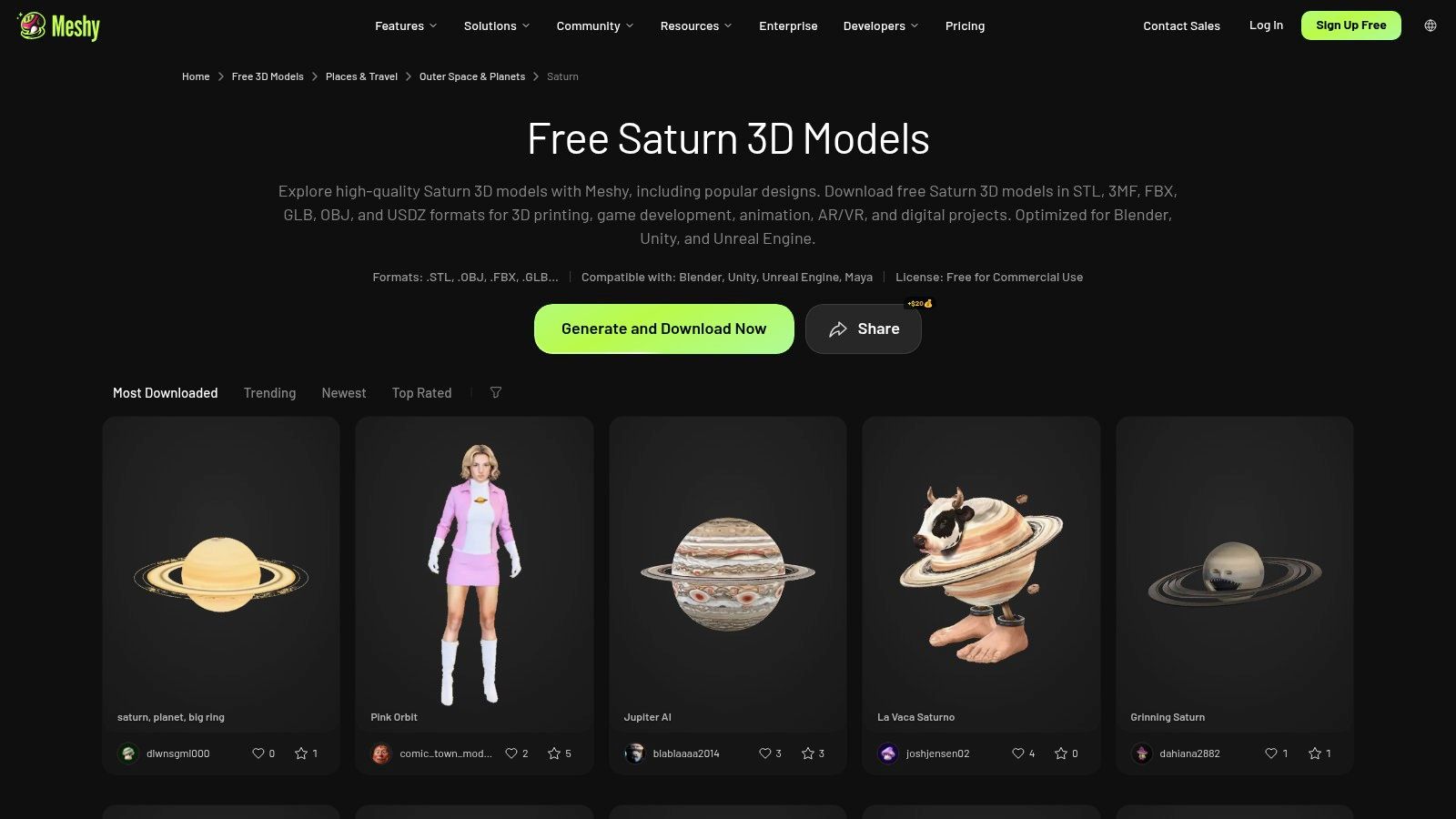
The license is where people get burned. Gallery assets and models generated on a free plan can carry different terms. Read the terms for that asset and that plan before the file goes into a client scene or a product shot. I don't treat "free account" as "commercial clearance."
NASA's Cassini occultation write-up reports that occultation data mapped ring structure in three dimensions, with tightly packed particle clumps separated by nearly empty gaps. A generated disk often misses that. Inspect gaps, opacity, and whether the rings are a separate surface before you call the mesh production-ready. AI geometry varies, and downloaded meshes may still need cleanup.
4. Sketchfab, AllThingsSpace Saturn
AllThingsSpace's Saturn model on Sketchfab is a downloadable textured asset with an interactive preview. The listing reports 223.2K triangles and a CC Attribution license. You can orbit it in the browser before you commit, which is more than many free zips offer.
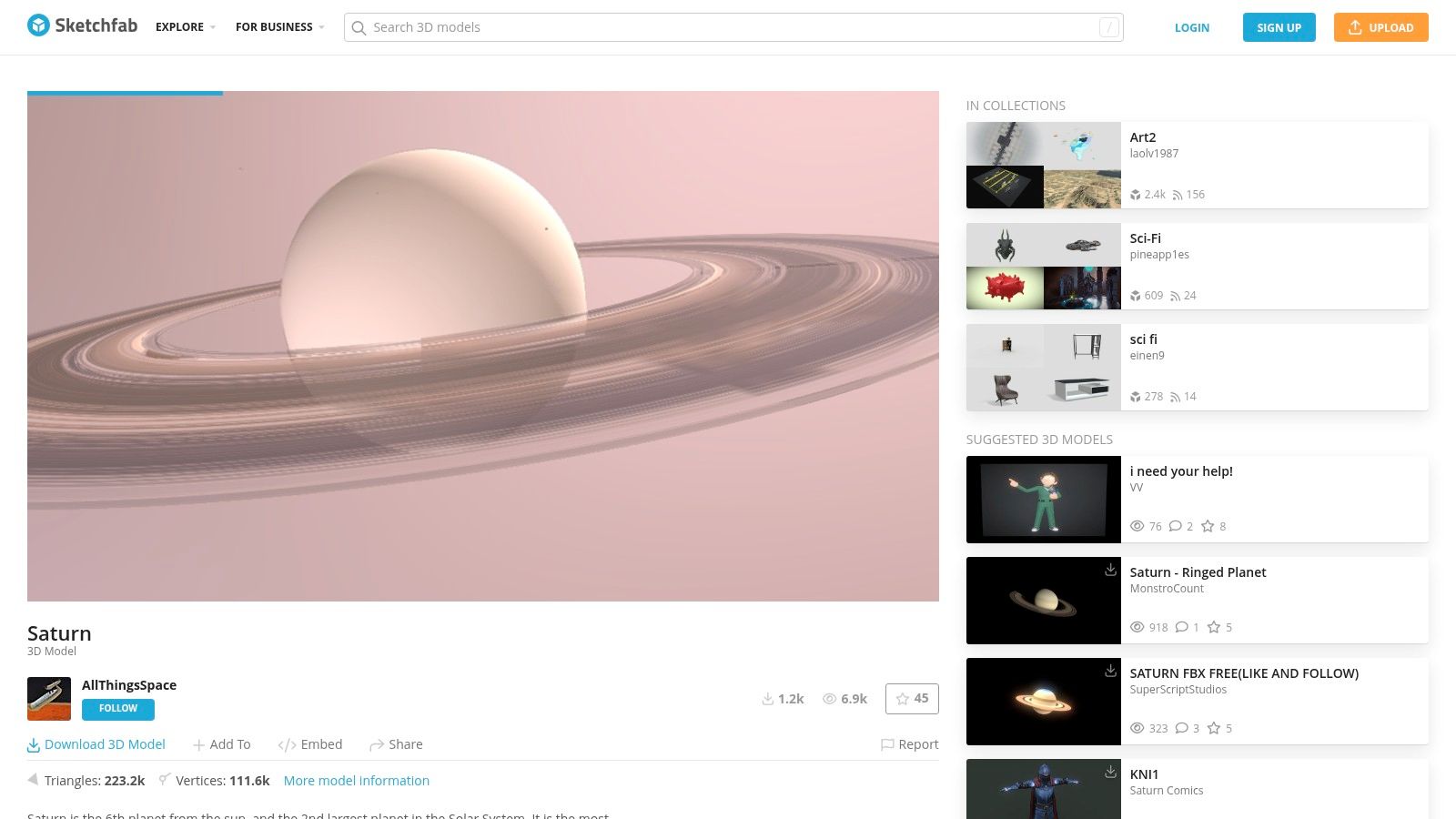
That triangle count is a render number, not a mobile number. It's a reasonable candidate for a detailed still or an educational visualization if you can live with attribution on the credit roll. It is a poor default for a phone AR scene or a lightweight game level unless you decimate first.
NASA's Saturn facts page puts the rings out to about 282,000 kilometers (175,000 miles) from the planet, with the Cassini Division about 4,700 kilometers (2,920 miles) wide. A heavy textured disk can still hide those gaps. Check the listing for which formats and texture maps come in the download, and keep the CC Attribution line in the project notes. Attribution isn't optional under the license the page states.
5. Sketchfab, Saturn by aenrae
The Saturn model by aenrae is useful for judging surface and ring treatment in a browser preview before bringing an asset into a project. The creator describes texturing it in Substance Painter, a workflow suited to rendered scenes where painted detail matters.
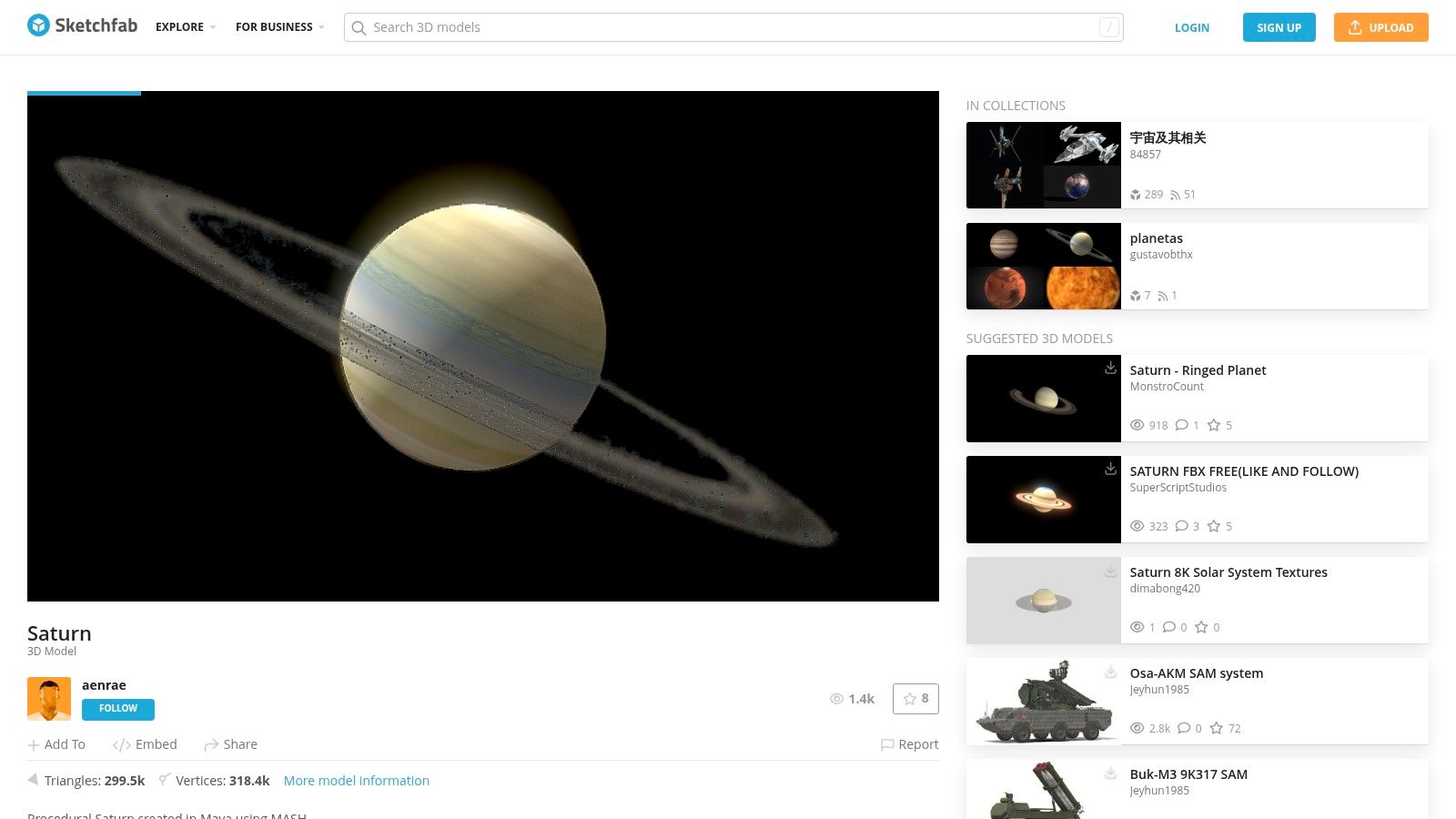
Before planning around the model, check the Sketchfab listing for Saturn by aenrae for download availability, license, file formats, and mesh topology. The listing's current terms determine whether it fits a production pipeline. Printability is not established, so do not choose it for fabrication without confirming the mesh is suitable.
Use the preview to assess whether its look adds something beyond the AllThingsSpace option. If the live listing is view-only, it cannot serve as a downloadable asset for your project. For rendering, confirm that the available files and license meet your delivery requirements before committing to the model.
6. BlendKit, Free Saturn Asset
BlendKit's free Saturn asset is built for a Blender scene, not a universal pipeline. The listing describes sunlight set up for Cycles and reports a 332-polygon model under a CC0 license. CC0 is the simplest reuse language on this list, provided you still read the page you're downloading from.
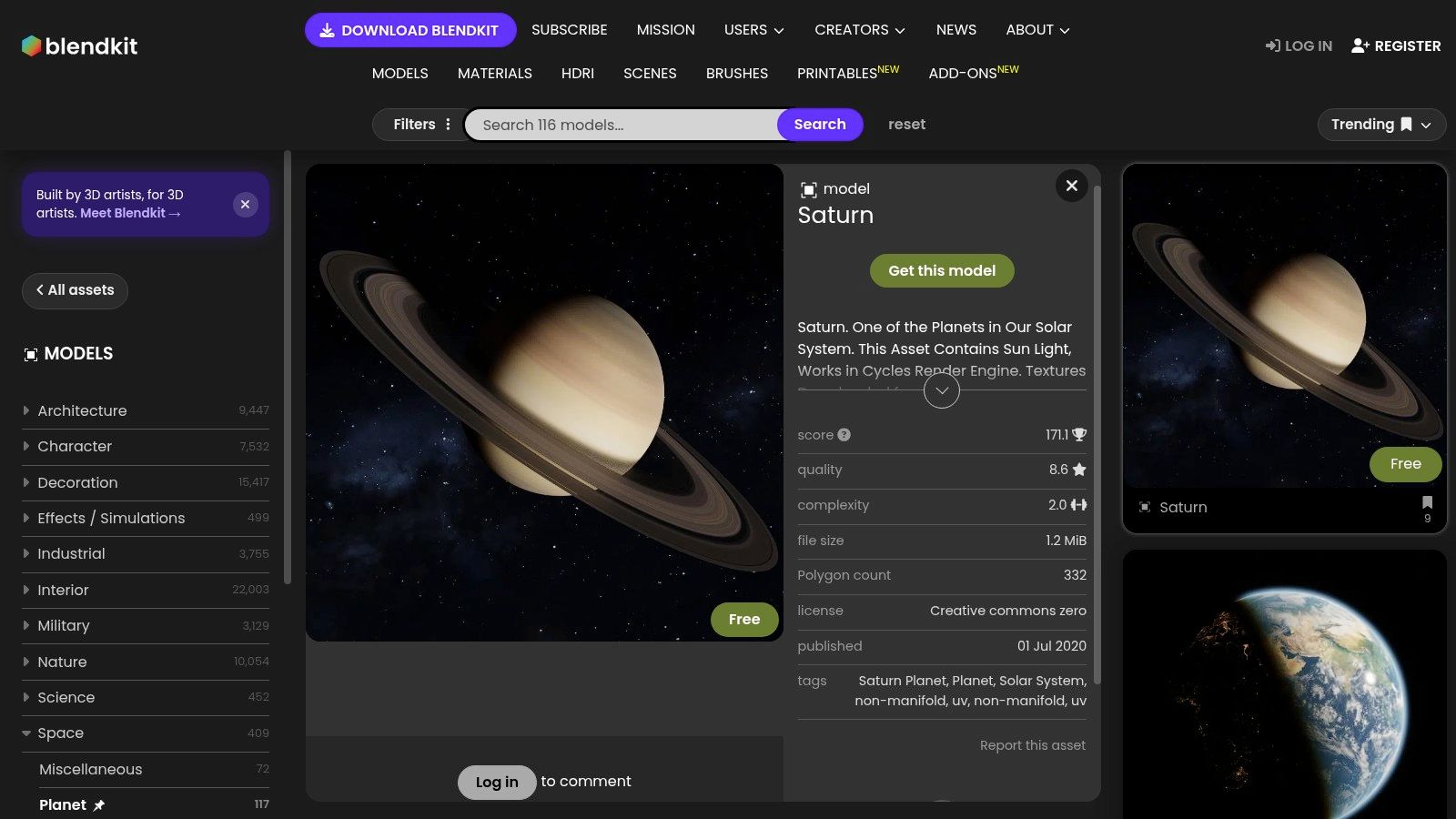
Three hundred and thirty-two polygons is a background prop. It will sit unobtrusively in a wide solar-system shot and it will fall apart in a close-up. The same page marks the model as non-manifold. That single flag takes printing off the table until you repair the mesh, and even then I wouldn't assume the rings are thick enough to manufacture.
Use it when:
- The scene is already Blender and Cycles: Lighting is part of the download, so you're not rebuilding a sun from scratch.
- You want a light placeholder: Low density beats a 200K-triangle import when Saturn is small in frame.
- License friction is the main blocker: CC0 is easier to hand to a producer than a CC Attribution file.
Non-manifold isn't a style choice. It's open edges and faces that a slicer will reject and that some exporters will quietly break.
If you only need a throwaway test mesh while you learn an importer, a free 3D cat model is a cleaner experiment than forcing this Saturn through a print workflow it wasn't built for.
7. Spacecraft Kits, Saturn and Its Rings STL
Spacecraft Kits publishes free Saturn and rings STL files that are meant for a printer, which already puts them ahead of most gallery downloads. The model includes an oblate planet, major ring structures, and a flat underside. Variants come with and without a connecting planet-shadow band, and a smaller, sturdier version is available when the detailed rings are too fragile.
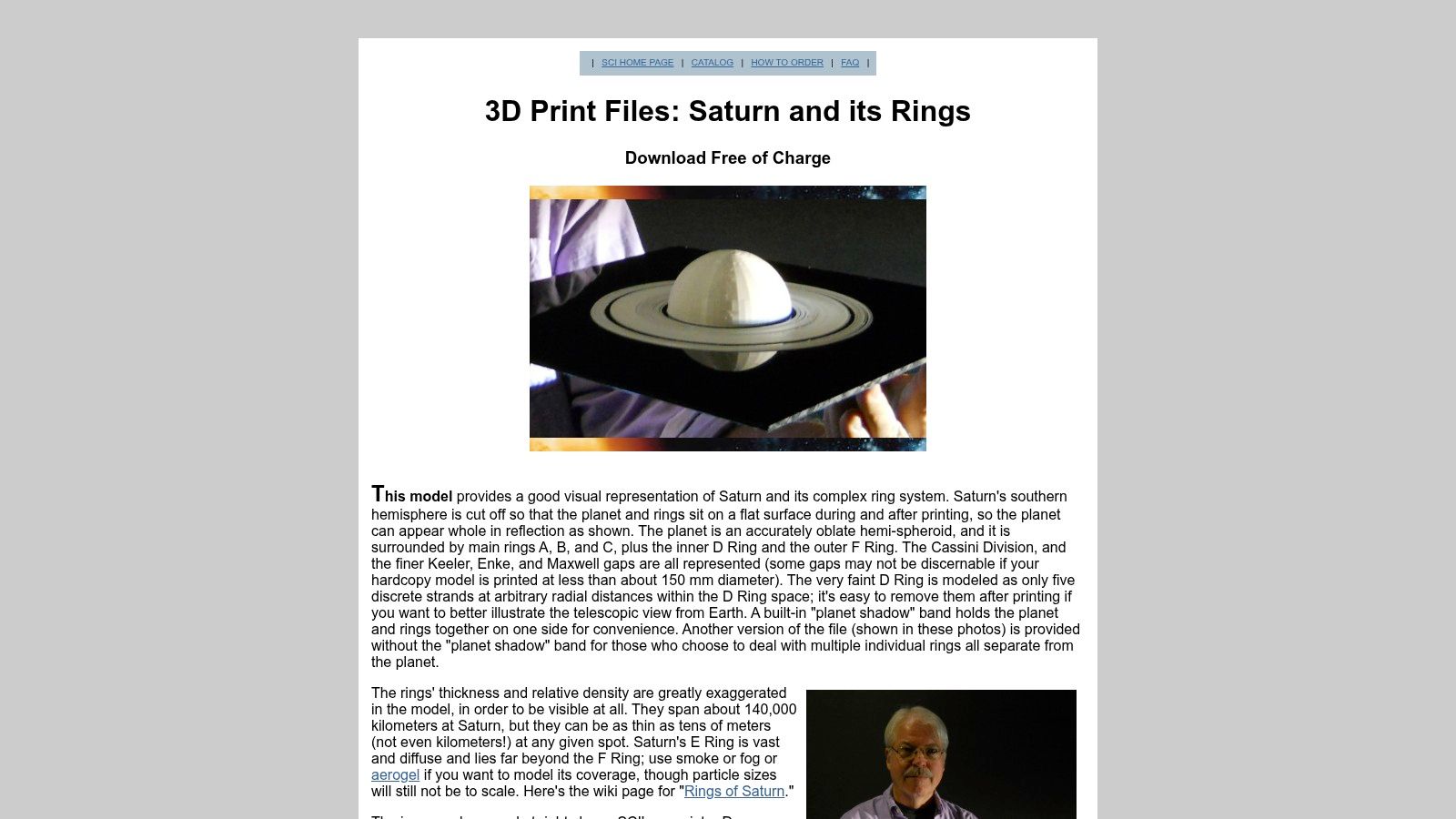
Ring thickness and density are exaggerated so the features survive as plastic. That is the right compromise for a tabletop model and the wrong file if you need a to-scale cross-section. Fine gaps may vanish on a small print. Some versions are delicate and need orientation, supports, and a printer that can hold thin walls.
A documented solar-system print project used rings about 0.3 mm thick and had to split them to fit an Ender 3 Pro bed. The same project could show the Cassini Division but not the narrower Encke Division at that scale. Read the Spacecraft Kits notes the same way: label what is scientific and what was thickened so the part would exist.
If you're still choosing an export for the slicer, start with what file type 3D printers use and match the STL to the machine before you chase extra ring gaps.
8. TurboSquid, Saturn by EdPlus
EdPlus's Saturn model on TurboSquid is listed at $10 and is the most format-explicit paid file in this set. The listing includes FBX, OBJ, STL, and Collada (DAE), plus UV mapping, materials, and textures that include normal maps. It also reports 34,560 polygons and 17,282 vertices.
That mid-range density is easier to place in a DCC scene than a 200K-triangle Sketchfab download, and the multi-format bundle means you're less likely to convert on day one. Standard TurboSquid license options are shown on the listing. Read the one that matches your use before you buy. A $10 file with the wrong seat or the wrong commercial scope is more expensive than a free CC0 prop.
The STL is the trap. An STL in the zip doesn't mean the mesh is watertight, that the rings are a printable thickness, or that normals are consistent. I would buy this for a documented render or animation asset, then test the STL in a slicer only as a separate experiment. If the slicer reports open edges, you paid for a render mesh, not a physical part.
9. CGTrader, Free Saturn Planet Model
CGTrader's free Saturn Planet model is a catalog entry more than a finished brief. The page indicates FBX and sits in the free 3D model catalog, with seller and asset details on the marketplace listing. FBX is a normal interchange format for games and DCC, so this can be a shortcut when you don't want to model a sphere and a disk yourself.
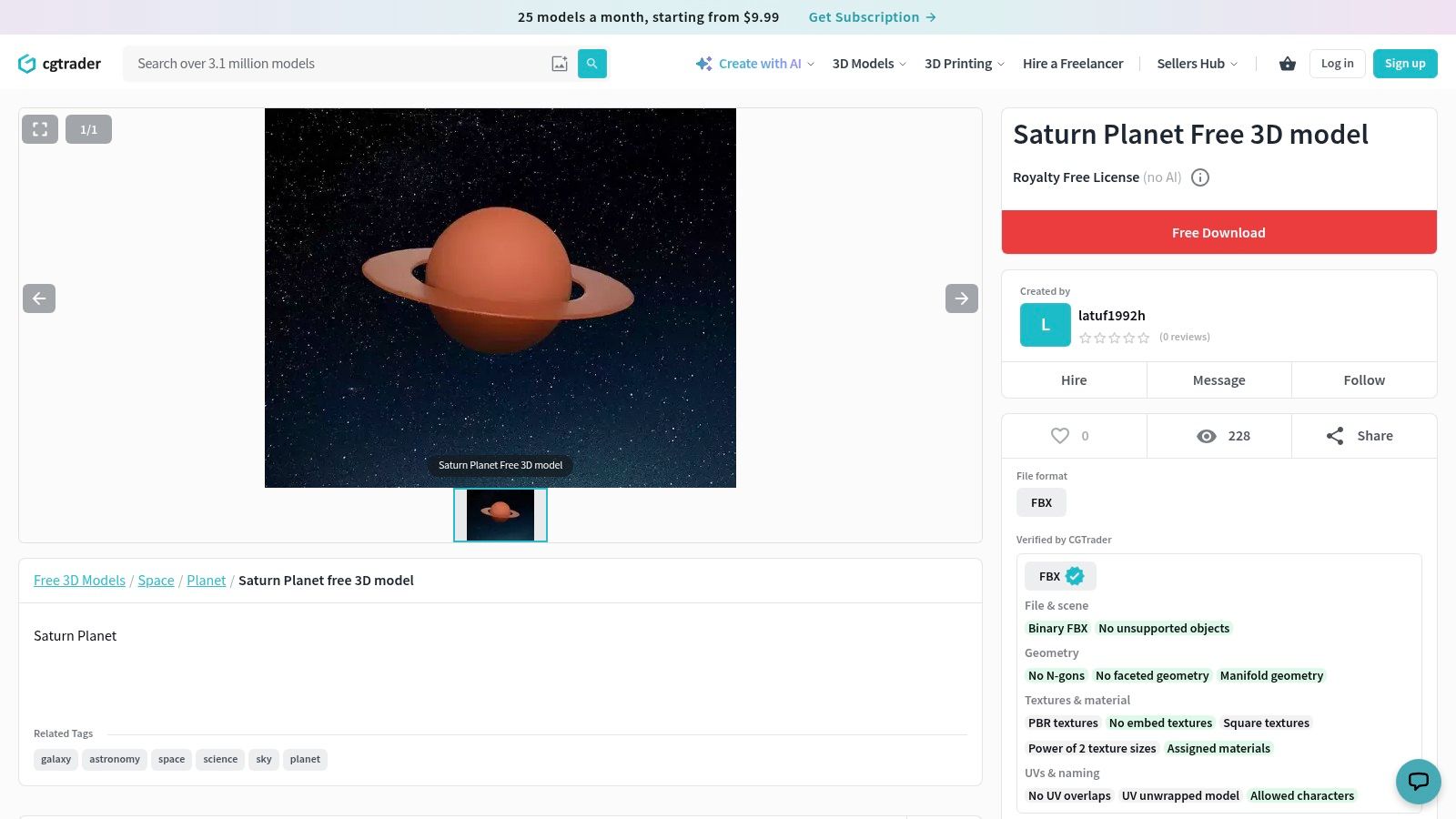
What the available information doesn't confirm is texture quality, topology, polygon count, or printability. FBX may also need a conversion if your viewer wants glTF or your slicer wants STL. Treat "free" and "FBX" as the start of the check, not the end.
Before you import it:
- Open the product page: Confirm the license, the download requirements, and whether textures are included or external.
- Inspect the mesh: Look for non-manifold edges, flipped normals, and rings welded to the body.
- Match the destination: A game or viz scene is plausible. A print is not established.
If the scene needs a second body with the same material rules, a 3D sun model is a separate asset decision. Don't assume this Saturn file's license covers whatever else you drop into the same shot.
10. Solar System Scope, Printable Paper Saturn Model
For a classroom display without a slicer or 3D printer, Solar System Scope's Saturn papercraft PDF gives you a direct route from printout to assembled model. The free template has 60 faces and lists approximate finished diameters of 80 mm on A4 paper and 115 mm on A3 paper. Print, cut, and fold it; no 3D software is required.
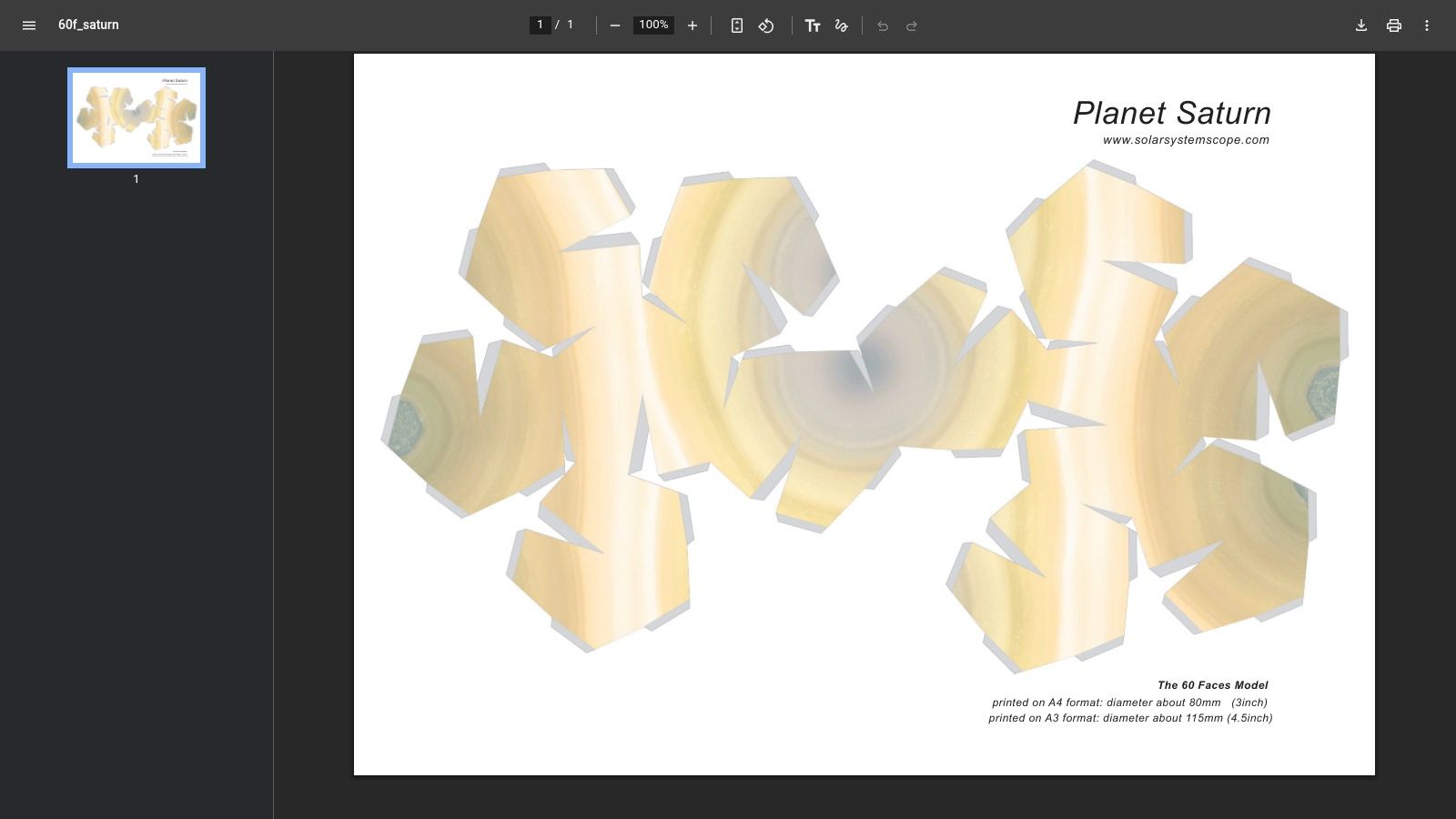
The format sets clear limits. This is a paper craft template, not an editable 3D model: you cannot remesh it, import it into Unity as a model, or adjust the ring in a slicer. It will be less durable than printed plastic and less detailed than a textured render. Cutting and folding all 60 faces takes time, especially when preparing a classroom set.
Before distributing copies beyond your own classroom or display, check the template's license on the Solar System Scope download page. The PDF is suited to a one-afternoon physical display, but it is not a substitute for a printable plastic model or an asset for real-time scenes. For digital PDF sales, pricing PDF downloads for UK buyers offers general pricing guidance, not permission to resell this template.
How the 10 Saturn 3D Model Options Differ by Use Case, Format, and License
| Item | Best for | Listed formats | Price and license | Print readiness |
|---|---|---|---|---|
| Sculpty (recommended) | Creating and refining custom 3D assets in one browser-based workflow | GLB, STL, OBJ, FBX, USDZ, 3MF | First model free; paid plans include commercial rights; prices unspecified | STL and 3MF supported; check generated meshes before printing |
| NASA Science, Saturn 3D Model | Educational displays, visualization, and AR | glTF, USDZ | Free; review NASA usage guidance for commercial use | Not listed as print-ready; no STL provided |
| Meshy, Saturn Models and Generation | Browsing Saturn assets or generating a custom model | STL, OBJ, FBX, GLB, USDZ | Free account required to download; licensing varies by asset and plan | STL available; inspect and test meshes |
| Sketchfab, AllThingsSpace Saturn | Textured renders and educational visualization | Not specified | CC Attribution; attribution required | Print readiness not specified |
| Sketchfab, Saturn by aenrae | Previewing and comparing Saturn visual styles | Not specified | Verify current license and download availability | Not documented |
| BlendKit, Free Saturn Asset | Lightweight Blender scenes and Cycles rendering | Not specified | Free; CC0 stated on listing | Non-manifold; not assumed print-ready |
| Spacecraft Kits, Saturn and Its Rings STL | 3D printing a Saturn with visible ring details | STL | Free | Designed for printing; small details and delicate variants may need care |
| TurboSquid, Saturn by EdPlus | Multi-format modeling and rendering workflows | FBX, OBJ, STL, Collada (DAE) | $10; review license options | STL included, but print suitability is not guaranteed |
| CGTrader, Free Saturn Planet Model | Game, scene, or visualization projects | FBX | Listed as free; check listing license | Print readiness not confirmed |
| Solar System Scope, Printable Paper Saturn Model | Classroom or display papercraft without a 3D printer | Free template | Printable paper craft; not a 3D-printable mesh |
Match the Saturn Model to Your Destination Before You Download
Choose by destination, not thumbnail. A strong render asset can still fail in a real-time scene, a slicer, or a classroom.
Start with the job. For a film or marketing still, AllThingsSpace offers detailed geometry, while the EdPlus TurboSquid file includes documented maps and several DCC formats for $10. Both have trade-offs: AllThingsSpace carries 223.2K triangles and requires attribution; EdPlus still needs a license check. For real-time scenes or AR, consider NASA's glTF or USDZ, or a generated GLB that you can decimate. For printing, start with the Spacecraft Kits STL rather than assuming a render mesh with an STL export will print well. For classroom display without a 3D printer, the 60-face PDF is the paper-craft option.
Check the format before downloading. glTF and USDZ suit presentation workflows; FBX, OBJ, and DAE are interchange formats, while STL and 3MF are common slicer inputs. If the listing does not name a format your software opens, expect to convert the file. Conversion can affect ring thickness, scale, and materials. Sculpty is useful when you want to inspect a generated mesh before choosing an export format.
Read the license on the listing. BlendKit's page states CC0, so check that the listing still shows that license when you download. CC Attribution requires credit to accompany the work. NASA's free download still calls for a review of its usage guidance before commercial use. Meshy gallery assets and generations made on its free plan have different licensing terms. TurboSquid's paid options also depend on the license selected.
Then check the geometry. Run a non-manifold inspection before printing, especially for the BlendKit asset, which is flagged for that issue, and for AI exports. For a real-time scene, test a low-poly stand-in in the target engine before committing to a heavier Sketchfab download. Paper craft needs cutting time, not mesh checks.
Shortlist two or three options that fit the job. Before building a scene, setting up a slicer profile, or preparing a lesson, confirm each listing's formats, polygon count, and license.
If you need to generate a Saturn model and then adjust its topology, Sculpty brings text-to-3D and image-to-3D engines into one browser workflow. It also provides PBR texturing, remeshing, and exports for Blender, Unity, and slicers. Keep the planet and rings as separate meshes when that suits the destination, then export in a supported format such as GLB, STL, USDZ, or 3MF. Start building your Saturn model at Sculpty.