
7 Spaceship Models 3D: Ideas to Model, Render, and Print
The most common advice for spaceship models is to add more detail. That's often the wrong starting point. A hull covered in vents, panels, and machinery can look convincing in a still image yet become difficult to animate, expensive to render, or impossible to print cleanly. A great spaceship model starts with the end use, not the density of its surface detail.
Before choosing a spacecraft, decide whether you're building a cinematic hero asset, a real-time game object, a browser preview, or a physical model. That decision should influence everything from reference selection and mesh organization to material complexity and export format. A panel seam might need geometry for a close-up, a normal map for a game, or deeper relief for a desktop print.
For artists searching for spaceship models 3D references, recognizable ships offer useful production exercises. The examples below approach each design as a different technical challenge, from asymmetric hard surfaces and animated wings to engineering references and tall printable assemblies. Choose the challenge that matches your next deliverable, rather than just your favorite silhouette.
Table of Contents
- 1. Millennium Falcon (Star Wars)
- 2. USS Enterprise NCC-1701 (Star Trek)
- 3. Normandy SR-2 (Mass Effect)
- 4. Frigate Rifter (EVE Online)
- 5. Orion Spacecraft (NASA Artemis Program)
- 6. Starship (SpaceX)
- 7. X-Wing Starfighter (Star Wars)
- 7 Best 3D Spaceship Models Compared
- Build a Pipeline That Survives Every Destination
1. Millennium Falcon (Star Wars)
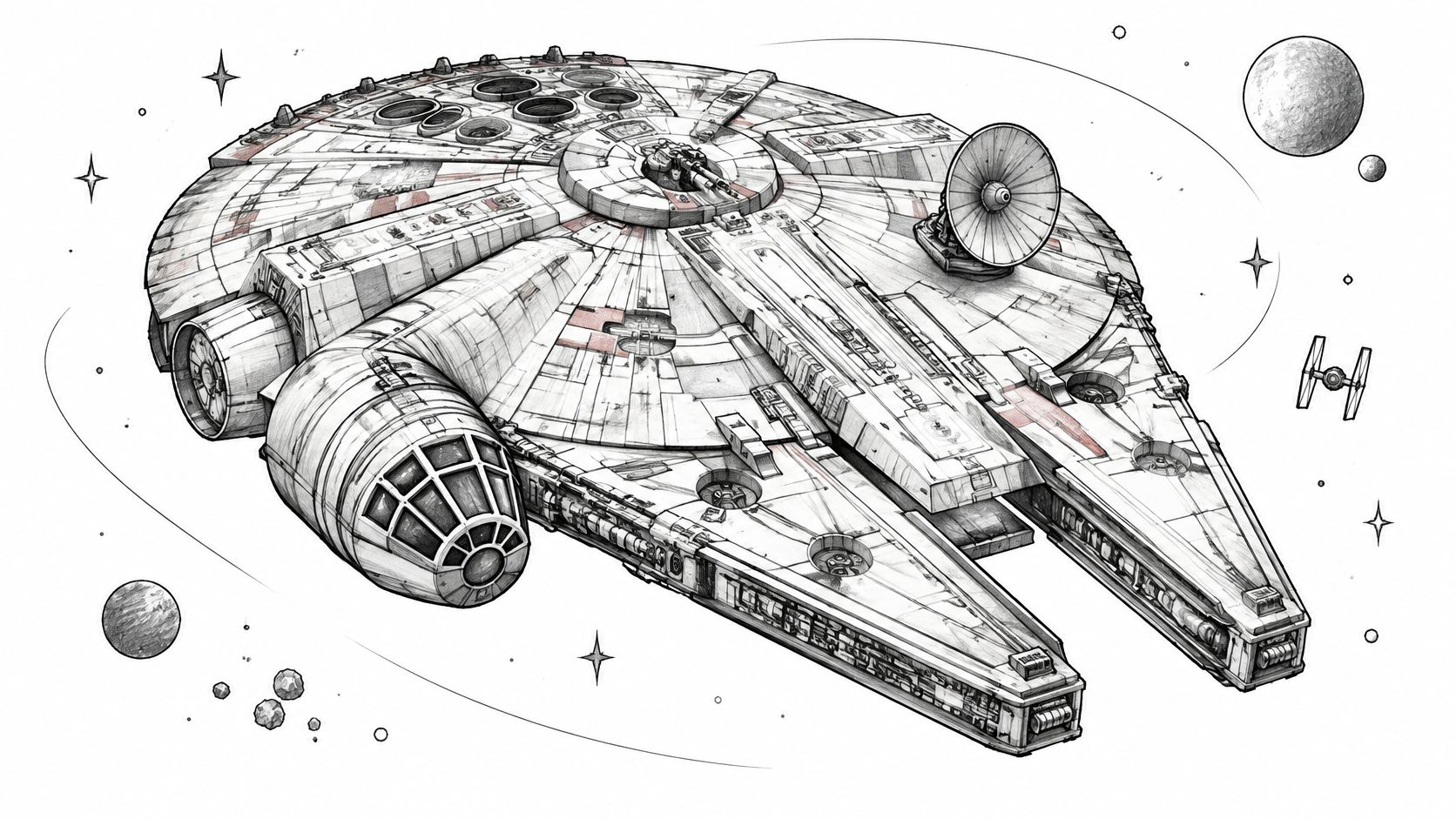
Treat a Millennium Falcon study as an exercise in controlled asymmetry. Block out the main hull, forward projections, cockpit corridor, and engine opening before adding pipes or mechanical inserts. Check the silhouette from above and from low viewing angles, because surface clutter won't rescue incorrect proportions.
Use consistent reference views rather than combining unrelated interpretations. A UK collector's Star Wars poster guide can support a separate visual-reference search, but promotional artwork shouldn't replace aligned modeling references. Perspective, dramatic lighting, and composition can make measurements unreliable.
Separate structure from surface noise
Build the hull as editable primary surfaces and organize greebles into removable collections. Follow a deliberate hard-surface modelling workflow, keeping bevels, panel recesses, and mechanical inserts adjustable until the camera distance is established.
- For a cinematic asset: Retain geometry where recesses cast visible shadows or interrupt the silhouette.
- For a game asset: Bake shallow machinery into normal maps and simplify details that disappear at gameplay distance.
- For a print: Merge overlapping decorative parts where appropriate, strengthen narrow connections, and inspect recessed channels in the slicer.
Practical rule: If removing a detail doesn't change the silhouette, shading, or intended close-up, question whether it needs geometry.
For a portfolio hangar scene, concentrate detail around the boarding area and camera-facing hull instead of distributing it uniformly. Keep a separate printable derivative rather than forcing the render mesh to serve both purposes. Before distributing a recognizable replica, verify permissions for the design and any downloaded components.
2. USS Enterprise NCC-1701 (Star Trek)
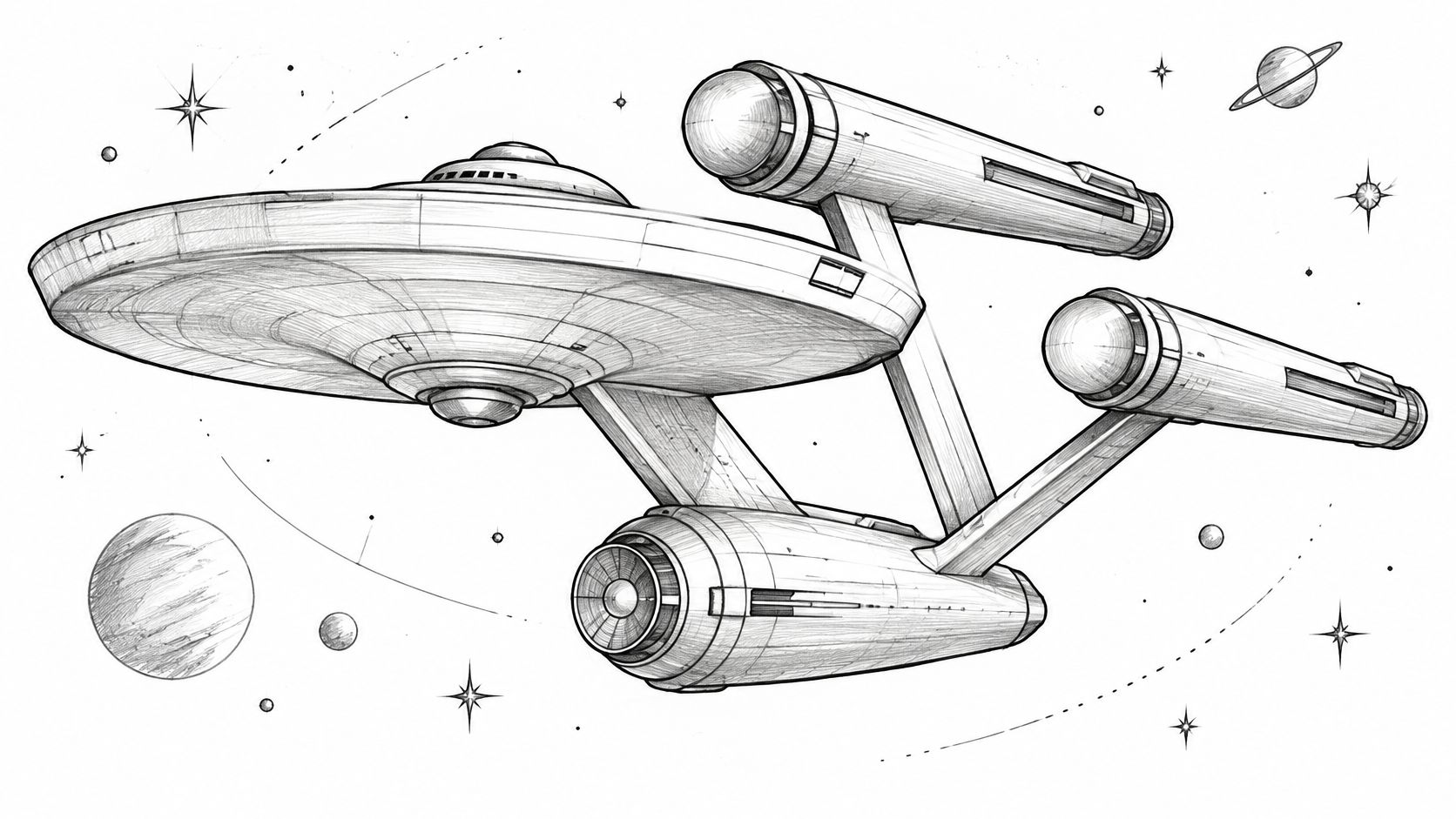
An Enterprise study exposes proportion errors that dense mechanical detail might conceal. Treat the saucer, secondary hull, nacelles, and connecting supports as separate forms, then judge their relationship in a neutral material. Don't begin with windows and markings.
Choose a single reference interpretation before modeling. Mixing reference versions can produce a ship that looks plausible in isolation but inconsistent when compared with the intended subject. Keep reference notes with the project so a client or collaborator can understand those decisions.
Make clean surfaces earn their simplicity
Mirror symmetrical components during construction, then inspect the center seam and shading after applying modifiers. On broad curved surfaces, uneven edge spacing and poorly controlled normals can become obvious under grazing light. Use a rotating area light during review rather than relying only on a flattering studio setup.
For a game-ready version, apply modeling-for-games principles to the complete asset, including material slots, collision proxies, and screen-space detail. A distant fleet asset doesn't need the same window geometry as a close-up bridge shot.
- Display render: Prioritize smooth curvature, controlled reflections, and legible markings.
- Physical model: Consider thicker supports, keyed joints, and separately printed nacelles.
- Client review: Provide a turntable with neutral lighting so alignment problems remain visible.
A desktop display commission is a useful test scenario. Preserve the visual relationship between the major assemblies, but discuss structural compromises before manufacturing. Increasing support thickness may be a better decision than delivering a fragile replica that only looks accurate in the viewport.
3. Normandy SR-2 (Mass Effect)
Start a Normandy SR-2 study with the intended game camera, not a close-up beauty render. Establish the hull's directional flow and wing-like profile, then test whether the ship remains readable against both bright and dark backgrounds. Engine glow should support that reading, not compensate for an unclear shape.
For a hypothetical docking sequence, keep the hull, engine assemblies, emissive surfaces, and moving components logically separated. Name parts by function so an animator can locate them without selecting through overlapping geometry. Put the asset origin somewhere useful for placement and movement, rather than accepting an accidental origin from generation or import.
Optimize for the shot and the engine
Use a dedicated emissive material or mask so you can adjust engine appearance independently of painted surfaces. Test emission with bloom disabled as well as enabled. Otherwise, post-processing may hide weak material boundaries or make the engines dominate every frame.
Retopology should follow the asset's behavior. Rigid hull sections need predictable shading and efficient triangulation; deforming components need topology suited to their motion. A 3D modeling topology guide is useful preparation before deciding whether to rebuild, remesh, or selectively repair generated geometry.
A mesh that looks clean in wireframe still needs testing under the lighting and movement it will actually receive.
Research on generated meshes identifies problems including intersecting faces, uneven topology, and UV overlaps, supporting the need for explicit mesh-quality inspection_2025_782-804.pdf). Don't assume an attractive preview means an asset is ready for production.
For engine delivery, test the exported FBX or GLB in the destination application. Inspect material assignments, normals, scale, and emissive behavior after import, not just inside the modeling package.
4. Frigate Rifter (EVE Online)
Use a Rifter-inspired modeling exercise to practice a reusable ship-family pipeline. Instead of sculpting every visible assembly into a single object, separate the core hull from armor, engines, weapons, and decorative machinery. That organization makes it easier to explore variants without rebuilding the entire asset.
For an indie space-combat prototype, a modular approach can help you test how related ships read together. Keep shared attachment conventions, orientation, and pivot placement consistent. Make variants visibly different through silhouette and major assemblies before relying on paint changes.
- Shared structure: Reuse mounting interfaces and recurring mechanical elements where they fit.
- Distinctive profile: Change meaningful protrusions or armor masses rather than scattering extra greebles.
- Controlled materials: Use a restrained material system with masks for paint, exposed metal, and wear.
- Distance testing: Remove small protrusions when they stop contributing to the rendered shape.
Build variants without multiplying cleanup
Keep an editable master assembly, then create delivery copies for optimization. Don't decimate the only version containing clean attachment surfaces and adjustable parts. When baking shared details, check that mirrored or overlapping UVs don't introduce unwanted directional wear.
Prompt-driven texturing can help explore paint treatments, but inspect the result for seams, inconsistent material response, and decorative marks that resemble unreadable lettering. Keep faction-style graphics separate from structural surface information whenever possible.
For a playable prototype, test the ship among similarly sized objects and under actual combat lighting. A detailed asset that becomes an indistinct patch at gameplay distance needs stronger visual hierarchy, not more texture resolution. If you're using the recognizable Rifter design rather than an original study, review the applicable rights before publishing or selling it.
5. Orion Spacecraft (NASA Artemis Program)
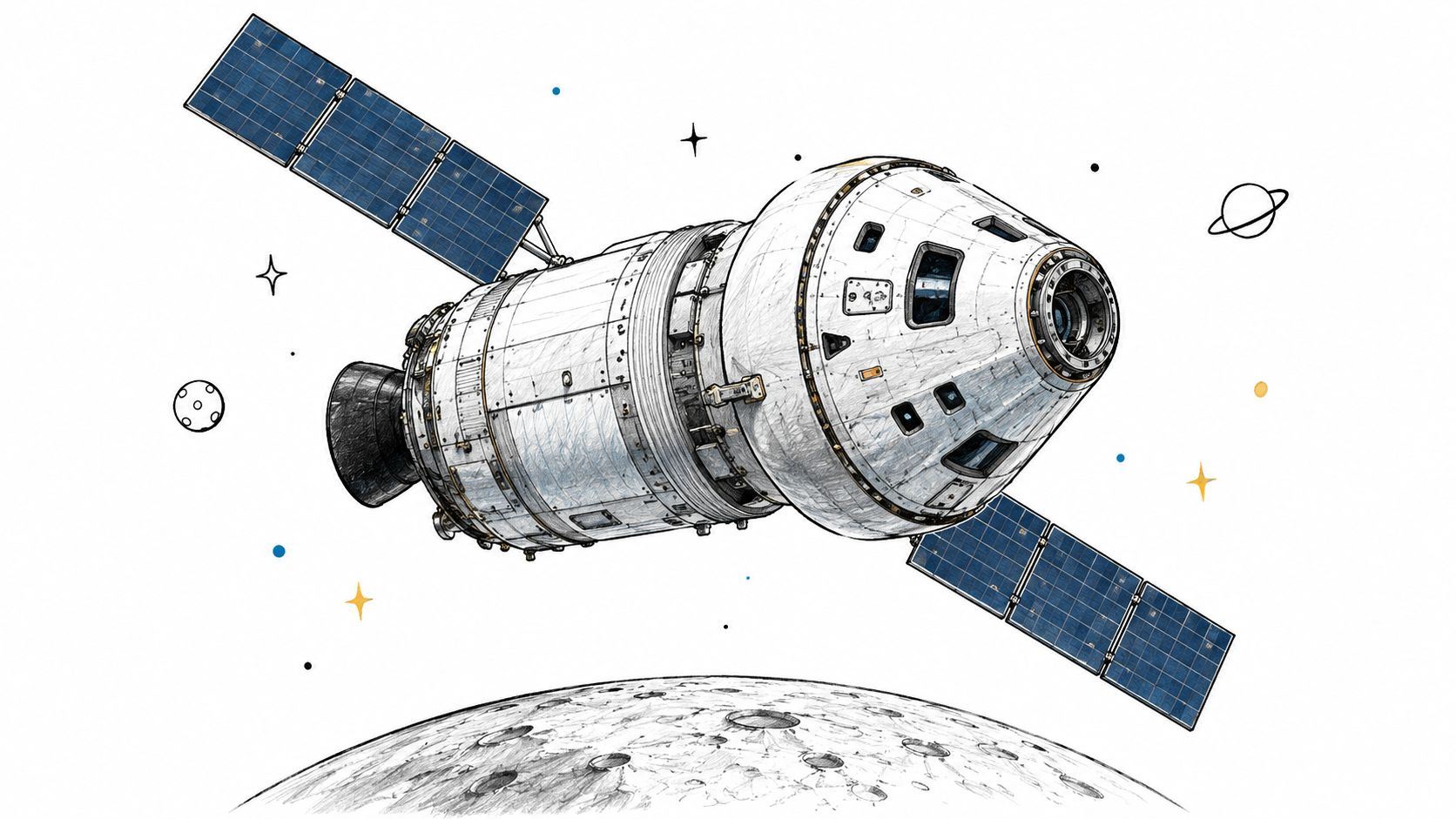
Approach an Orion model as a reference-verification exercise. For an educational presentation, identify the configuration you intend to represent, collect matching references, and record which components you've simplified. Don't label an interpretation engineering-accurate merely because its silhouette looks convincing.
NASA's public 3D resources provide downloadable spacecraft models, printable objects, textures, and visualization resources. Use that collection as a starting point for finding authoritative material, while checking the individual asset's provenance and suitability for your project.
Preserve function when simplifying
Separate major assemblies before optimizing them. Keep attachment points, exterior equipment, and presentation-critical features identifiable, even if you simplify their internal construction. For an interactive museum display, clear component organization may be more useful than dense hidden geometry.
NASA's Europa Clipper printable reference model offers a useful manufacturing comparison because its component layout was designed for standard FDM/FFF equipment. Apply that approach to an Orion print by reviewing part separation, unsupported details, and assembly access before export.
- Educational visualization: Document omitted components and distinguish interpretation from reference-derived geometry.
- Web presentation: Test the exported model's materials, orientation, and loading behavior in the target viewer.
- Physical fabrication: Verify units, wall thickness, mating clearances, and support placement in the slicer.
Public access isn't a substitute for checking permissions. NASA's Dawn dataset entry lists the dataset as publicly accessible while leaving its license unspecified, illustrating why availability alone doesn't settle reuse questions. Record the terms attached to the actual Orion asset you select, including any restrictions affecting identifiers, branding, or third-party material.
6. Starship (SpaceX)
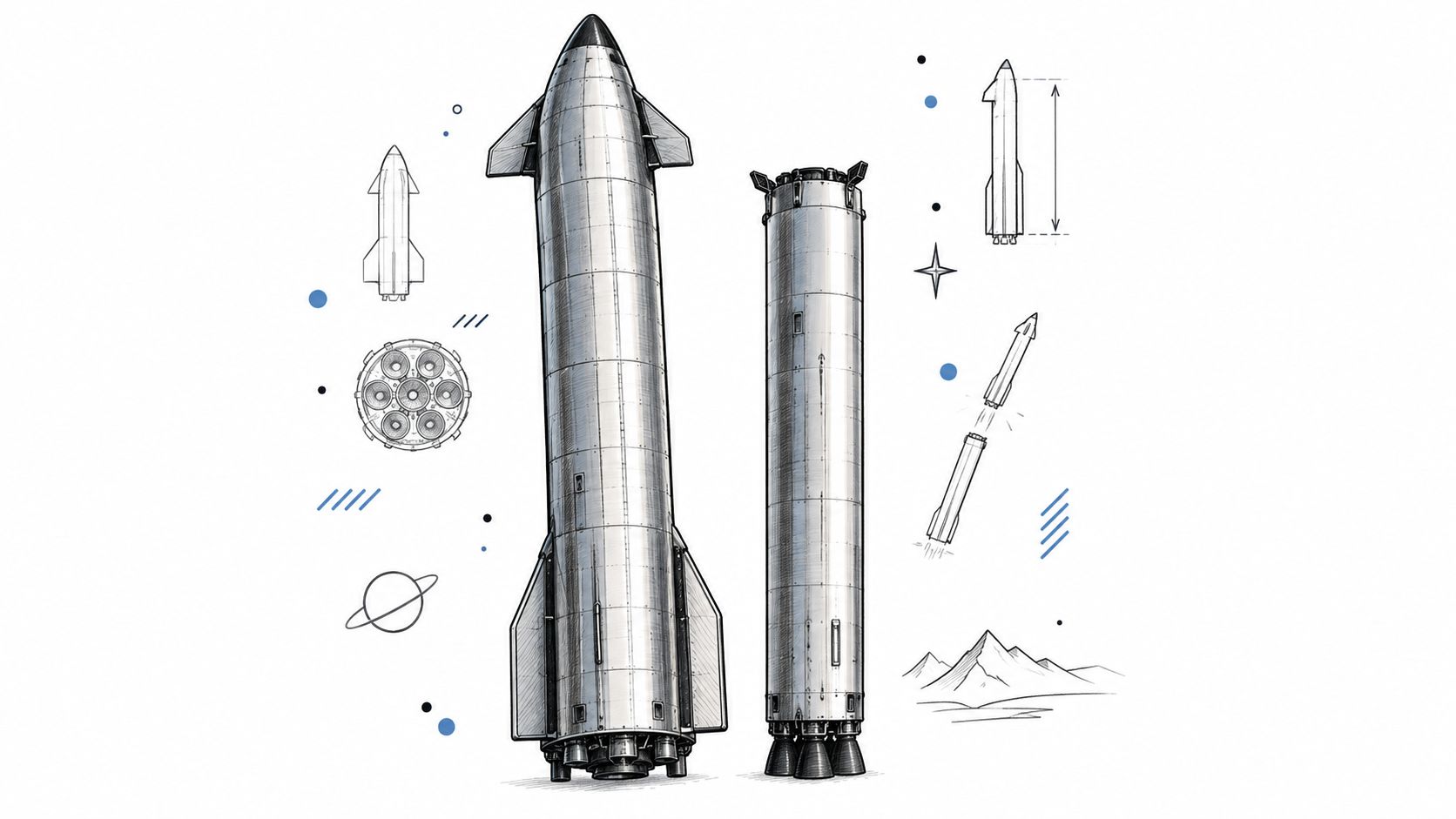
A Starship modeling project is a useful test of large cylindrical surfaces and configuration discipline. Select a dated reference set and keep it with the project. Don't combine details from different reference configurations unless the result is explicitly a concept interpretation.
Model the ship and booster as separate assemblies. Establish their relative proportions with simple geometry, then add engine openings, movable surfaces, seams, and exterior details appropriate to your chosen references. Keep repeated components instanced during construction so revisions remain manageable.
Solve reflections and fabrication separately
For a metallic render, inspect the hull under broad light sources. Excessive roughness variation can make the surface look dented, while perfectly uniform shading may feel overly pristine. Build material variation deliberately rather than using noise to disguise poor surface continuity.
For a tall physical model, consider sectional printing with keyed joints and an assembly plan. Place seams where they're accessible for finishing, and check that alignment features don't leave walls too thin. Inspect each exported section in the slicer before committing to the full build.
Fabrication insight: A visually accurate exterior and a practical internal structure don't have to use the same mesh.
ESA's Tropomi mirror redesign reduced component mass by 54% while preserving optical performance. That engineering case isn't a promise for a desktop rocket model, but it supports a useful principle: redesign geometry around a defined requirement.
For a collector display, that requirement might be stability, manageable assembly, or safe handling. Keep those priorities explicit, and don't describe a visual model as flight-ready or structurally validated.
7. X-Wing Starfighter (Star Wars)
An X-wing study becomes more useful when you treat it as a mechanical assembly, not a static silhouette. Build a reusable wing-and-engine module, then duplicate and position it consistently. Keep intentional asymmetry in materials or damage separate from the underlying mechanical alignment.
Set hinge pivots before adding final surface detail. Test closed, open, and intermediate poses, checking for intersections around the fuselage and adjacent assemblies. A convincing final pose doesn't guarantee that the motion between poses will work.
Choose between animation and printable strength
For animation, retain separate moving parts and clear transform hierarchies. Apply transforms deliberately, use consistent local axes, and verify that exported motion behaves correctly in the destination software. Rigid machinery usually benefits more from clean object organization than from unnecessary deformation topology.
For printing, decide whether the wings will be fixed or articulated before preparing the mesh. A fixed-pose model can use stronger integrated joints; an articulated version needs accessible assembly points and printer-appropriate clearances. Test a representative joint before fabricating the complete ship.
- Hero render: Spend geometry on wing edges, engine openings, and visible cockpit framing.
- Game prototype: Bake shallow mechanical details and test the open silhouette at gameplay distance.
- Display print: Strengthen vulnerable projections and plan a support or stand around the chosen pose.
Use motion reference to judge the relationship between moving assemblies, rather than relying exclusively on still images.
For a portfolio animation, include a neutral turntable alongside the finished shot so reviewers can inspect construction. Keep source credits and permission notes with the deliverable, especially when sharing recognizable franchise designs or third-party kitbash parts.
7 Best 3D Spaceship Models Compared
| Example | 🔄 Implementation Complexity | ⚡ Resource Requirements | 📊 Expected Modeling Outcome | 💡 Ideal Use Cases | ⭐ Key Advantage |
|---|---|---|---|---|---|
| Millennium Falcon | High: asymmetric hull and dense surface detail | Extensive references; optimization may be needed for real-time use | Detailed, weathered hero asset with a strong silhouette | Hard-surface practice, animation, games, and 3D printing | Highly recognizable design with abundant reference material |
| USS Enterprise NCC-1701 | Low to moderate: clean, symmetrical, modular geometry | Moderate references; select a consistent design era | Readable starship suited to turntables and display | Learning symmetry, panel layout, lighting, and 3D printing | Efficient to model and easy to present from multiple angles |
| Normandy SR-2 | Moderate to high: exterior and interior must align | Moderate references; separate materials and LODs support game use | Streamlined, real-time-ready ship with emissive lighting | Game assets, cinematic scenes, and stylized modeling | Clean forms adapt well to real-time engines and variants |
| Frigate Rifter | Moderate: compact hull with variant and LOD management | Efficient base-hull workflow; consistent naming and textures | Optimized, scalable asset with faction-specific variants | Game pipelines, space sims, and UI icon design | Demonstrates efficient reuse across a ship catalog |
| Orion Spacecraft | Moderate to high: precision and hardware detail require care | Official NASA references and careful licensing checks | Proportionally accurate technical or educational model | Aerospace visualization, education, and museum displays | Reliable official reference supports technical accuracy |
| Starship | Low to moderate: simple overall form, detailed engines | Current reference images; large prints may need sectioning | Scalable launch vehicle model, printable in separate stages | Educational visualization, display models, and 3D printing | Distinctive geometry is quick to model and scale |
| X-Wing Starfighter | Low to moderate: symmetry is simple; articulation adds rigging | Moderate references; reinforcement may be needed for printing | Modular fighter with animated S-foils | Hard-surface practice, animation, portfolios, and prototypes | Symmetrical parts support efficient modeling and wing animation |
Build a Pipeline That Survives Every Destination
The best spaceship models 3D workflows move from intent to inspection. Define the destination, choose consistent references, establish the silhouette, and add detail according to its visible contribution. Only then should you optimize and prepare the final export.
Keep an editable source asset separate from delivery meshes. A cinematic version may retain layered materials and dense mechanical assemblies, while a game version needs deliberate simplification and a printable version needs sound physical connections. Trying to maintain every requirement inside a single mesh usually makes revisions harder.
Judge the handoff, not just the render
Inspect the exported file in the application that will use it. In Blender, review shading, object organization, UVs, and transforms; in Unity, test materials, scale, collision, and distance behavior. In a slicer, examine thin features, disconnected islands, support access, and assembly orientation.
Before fabrication, assess the physical model with the same care you'd apply when selecting model building kits. Consider assembly order, fragile projections, finishing access, and how the completed object will be handled. A beautiful digital close-up doesn't answer those questions.
Keep evidence of the handoff: an imported viewport capture, a slicer preview, and a short note describing known limitations.
AI-assisted generation can help establish forms and explore alternatives, but inspect its output as incoming production material. Preserve recognizable components during cleanup, compare the silhouette against references, and rebuild areas where automated changes compromise the design. Evaluate the time needed to reach an acceptable deliverable, not just the time needed to generate a preview.
Finally, package provenance alongside geometry. Include the reference configuration, unit scale, intended use, export settings, known omissions, and applicable permissions. For fictional spacecraft, distinguish your own modeling work from rights in the underlying design; for real spacecraft, distinguish an agency-derived visualization from an engineering representation.
A useful handoff lets the next person open the file, understand its limitations, and continue working without reconstructing your decisions. That's a stronger measure of production quality than surface detail alone.
Sculpty offers browser-based text-to-3D and image-to-3D generation alongside PBR texturing, remeshing, retopology, rendering, and turntable exports. Visit Sculpty to develop a spaceship concept, then inspect and refine the exported mesh for your intended game, visualization, or printing workflow.