
Rome 2 Total War Factions by Playstyle
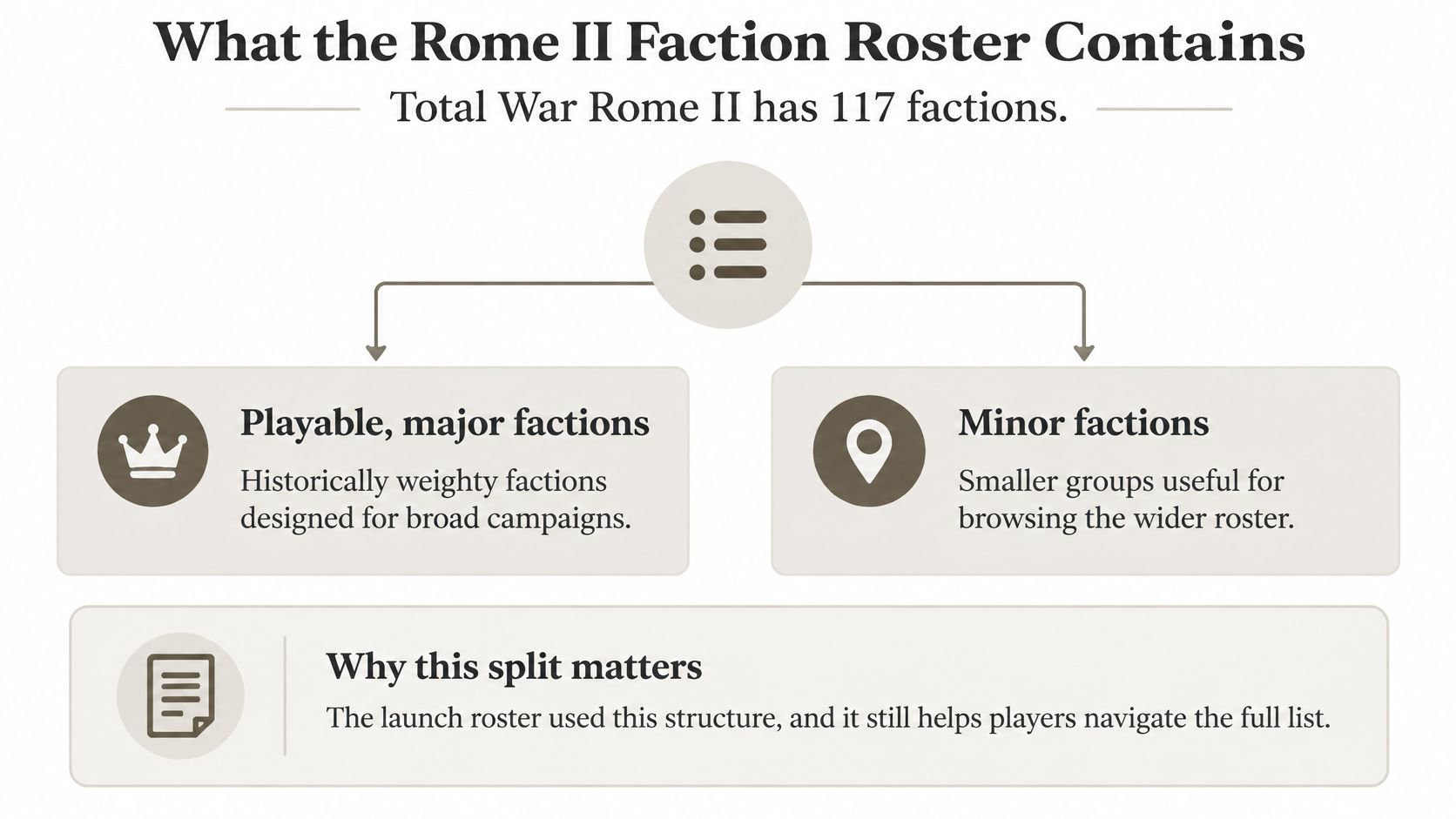
As of 2026, Total War: Rome II features 117 factions, according to Wikipedia's Total War: Rome II entry, yet most players still pick from memory, a poster, or a tier list that calls Rome best and stops thinking. That's the wrong cut. Pick Rome 2 Total War factions by constraint first: your culture, your political load, your first enemies, and the army you enjoy micro-managing. A faction that fits those four limits will outperform a stronger roster you hate steering.
Table of Contents
- What the Rome II Faction Roster Contains
- Reading Any Faction Card Across the 117 Roster
- Faction Selector by Playstyle Constraint
- Ten Cultures That Shape Every Faction
- Politics, Loyalty and When Bonuses Stop Paying
- Landmark Factions with Opening Plans
- Cross References for Campaign Systems
- Default Start and Turn One Lock-In
What the Rome II Faction Roster Contains
That 117 figure only helps if you sort it. The launch structure still works as your navigation layer. Major factions are the playable, historically weighty powers built for a full Grand Campaign. Minor factions are normally unplayable, but don't treat them as scenery. They recruit, expand, declare war, sign deals, and steal the province you were saving a depleted army to take.
At release, only eight factions were playable in the initial Grand Campaign, and you should learn those eight before you chase obscure starts. They were Rome, Carthage, Egypt, Macedon, Parthia, Suebi, Iceni, and the Arverni. Free updates and downloadable content later opened more starts and added separate campaigns, including settings such as the Gallic Wars and the Second Triumvirate. More choice didn't change the sorting problem. It made a disciplined filter more important.
The sorting key you will actually use
Every faction sits inside one of ten cultural groups: Hellenic, Latin, Punic, Celtic, Germanic, Desert Nomadic, Iberian, Tribal Nomadic, Balkan, and Eastern. Culture isn't flavor text. It drives your building architecture, the unit families you can recruit, and a large part of your diplomatic friction. A Latin start and a Tribal Nomadic start don't fail in the same way, don't expand at the same tempo, and don't want the same first buildings.
Faction traits then bend that cultural base. One faction inside a culture can lean toward trade, another toward public order, another toward military development or diplomacy. That's why a name alone is a poor pick. Two Celtic factions can share warband DNA and still present completely different campaigns because one starts isolated and the other starts surrounded.
Practical rule: If you can't name a faction's culture, its nearest hostile neighbor, and its signature unit family, you're not ready to start it.
Use the major and minor split to browse, culture to predict recruitment, and traits to predict tempo. Once you do that, the roster stops looking like a wall of 117 badges. It becomes a set of campaign shapes: settled Mediterranean powers, tribal confederations, eastern kingdoms, and mobile societies that don't want to sit behind walls and trade blows like Rome.
Reading Any Faction Card Across the 117 Roster
Read every faction card in the same order. Don't start with the coolest unit and work backward. Units mislead you when the province, politics, and technology don't support them.
The six fields in fixed order
- Culture first: Latin, Hellenic, Punic, Celtic, Germanic, Iberian, Balkan, Eastern, Desert Nomadic, or Tribal Nomadic. This tells you the building style and broad recruitment family before you look at elites.
- Major or minor status: A major faction is built as a playable campaign engine. A minor faction normally isn't playable, but a minor neighbor can still field armies and wreck your opening.
- Faction traits: Look for the economic, military, diplomatic, or political modifier that changes behavior. Ignore a small bonus if it doesn't change your first building, first technology, or first war.
- Starting provinces and neighbors: Count who can reach your first army. Two weak enemies on different fronts often cost more than one strong enemy with a clear border.
- Technology branches: Choose between civic, military, and engineering according to the job. Don't research down one universal path because a guide told a Roman player to do it.
- Signature units: Confirm the roster matches the culture and the terrain. A beautiful late unit doesn't rescue an opening with no answer for skirmishers, cavalry, or sieges.
Rome reads cleanly through this card. It's Latin, major, legionary heavy, with military organization and a complicated house system behind the army. Iceni reads differently: Celtic, major, tribal roster, sea buffer, simpler political shape, slower route into rich Mediterranean provinces. Neither card says best. Each card tells you what kind of management you're buying.
Apply the same six fields to downloadable content factions even when names, dates, and campaign maps change. Write down start region, culture, signature unit, party structure, nearest hostile neighbor, and first technology branch. That one small card beats scrolling through names and hoping a famous one fits your patience.
Faction Selector by Playstyle Constraint
Start with your constraint, not your favorite ancient logo. The official coverage describes starting positions, civic and military focuses, key units, agents, political systems, and technology trees, and the Total War wiki faction reference for Rome II notes the game contains 117 factions grouped across ten cultures. Breadth is useful only when you filter it by the campaign you want to play.
Playstyle selector for major Rome II starts
| Constraint | Faction | Culture | Why it fits | Watch-out |
|---|---|---|---|---|
| Beginner who wants strong infantry | Rome | Latin | Legionary roster, military development, public order | Multi-house politics and several fronts |
| Low political load over raw power | Iceni | Celtic | Isolated British start and tribal roster | Slower path into the Mediterranean |
| Cavalry and ranged mounted warfare | Parthia | Eastern | Horse archers and eastern cavalry doctrine | Poor if dragged into infantry sieges |
| Aggressive tribal early war | Suebi | Germanic | Raid tempo and Germanic infantry | Thin civic infrastructure later |
| Hellenistic pike line | Macedon | Hellenic | Phalanx core with cavalry support | Flanks and rough ground punish the line |
| Naval trade and western Mediterranean | Carthage | Punic | Commerce, fleets, and African and Iberian options | More than two political groups |
| Wealthy settled eastern start | Egypt | Eastern | Rich provinces and mixed roster | Neighbors pull wars in several directions |
| Gallic heartland expansion | Arverni | Celtic | Central Gallic position and Celtic roster | Early Roman or tribal pressure |
Choose Rome when you want the strongest straightforward military engine and you'll pay for it in administration. Legionary infantry forgives tactical mistakes because disciplined heavy troops hold formation while you fix a flank. Public order support and military development help expansion feel controlled. The cost is real: more political families, more fronts, and more reasons to check characters instead of marching.
Choose Iceni when you want fewer moving parts. The sea buys you reaction time, and you can consolidate before the expensive continental wars begin. You're trading immediate access to rich trade and elite Mediterranean recruitment for a safer learning curve. That's often the right beginner trade, even though tier lists undervalue it.
Parthia is my cavalry pick, with a condition. Play it only if you enjoy kiting, feigned retreats, ammunition management, and refusing fair infantry fights. If you plan to crash horse archers into spear walls because you're bored, pick Rome and save yourself the restart. Macedon suits players who like a visible plan: pikes fix the enemy, cavalry decides the battle. It punishes lazy deployment because a turned phalanx loses its main advantage fast.
Carthage fits traders and naval players who want options across Africa and Iberia before a decisive land confrontation. It is not Rome with boats. Its politics demand attention, and its strength comes from money, fleets, and choosing the theater. Egypt gives you wealth and a mixed settled roster, but wealth attracts wars, so pick one direction early. Suebi rewards aggression before infrastructure gaps bite. Arverni gives you the Gallic center and constant tribal diplomacy.
Strongest and easiest are not interchangeable. Rome can be more powerful and still harder to run than a quieter regional faction with fewer parties and fewer early enemies.
Before you commit, record culture, faction traits, starting provinces, major-faction status, technology branch, and signature units. Then add your own constraint in plain words: low management, cavalry battles, trade, defensive consolidation, or fast raiding. If the faction doesn't satisfy that sentence, don't start it because a ranking called it top tier.
Ten Cultures That Shape Every Faction
Culture is the parent system. The faction reference lists the ten cultural groups as Hellenic, Latin, Punic, Celtic, Germanic, Desert Nomadic, Iberian, Tribal Nomadic, Balkan, and Eastern, and the Total War wiki page on factions in Rome II explains that launch selection contained 117 factions with only 8 playable in the initial Grand Campaign, approximately 6.8% of all factions. That small launch slice already showed the design rule: culture sets the military grammar, then faction traits change the accent.
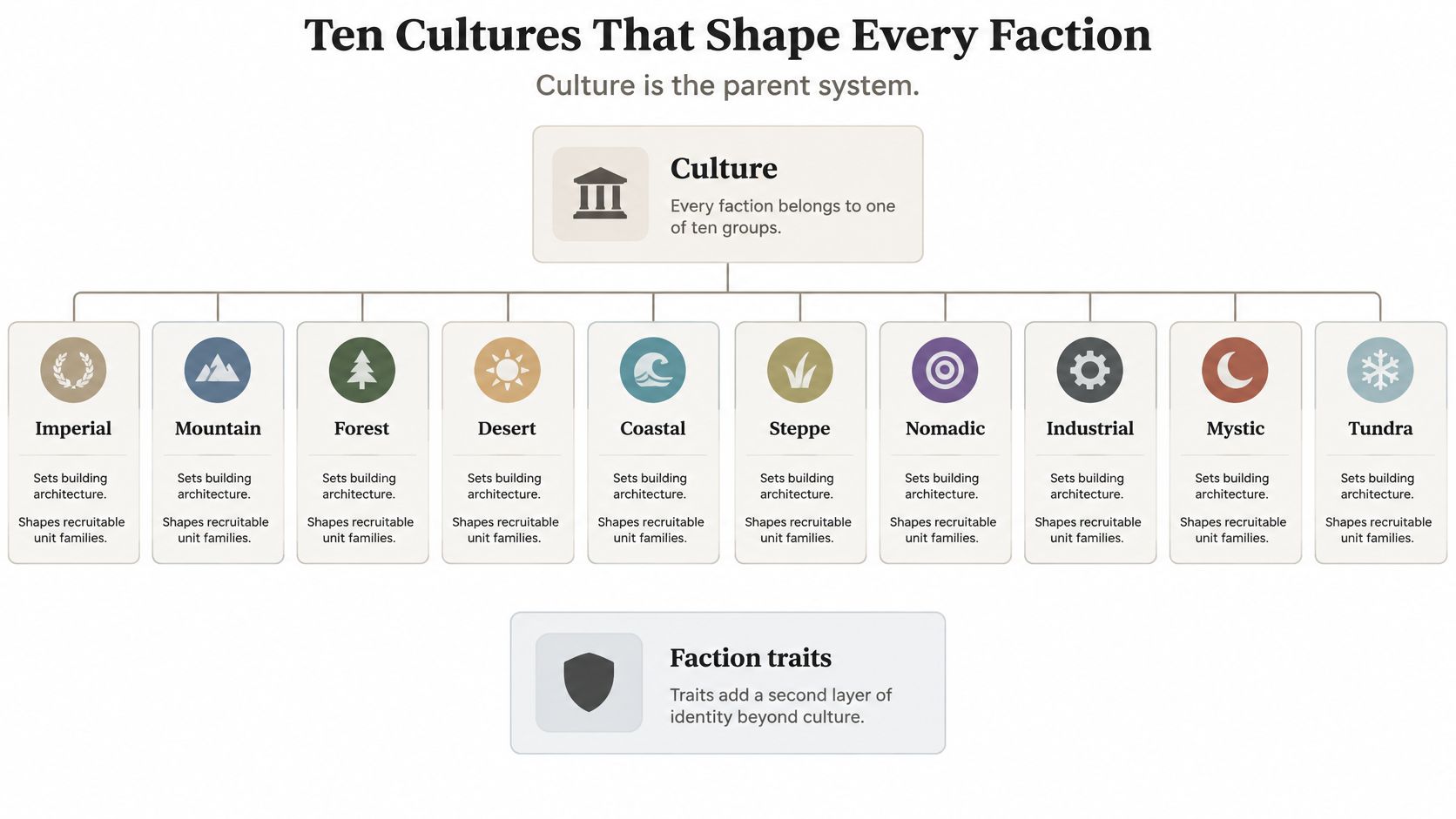
Ten culture groups and what they set
| Culture | Launch example | Signature unit idea |
|---|---|---|
| Hellenic | Macedon | Phalanx pike infantry |
| Latin | Rome | Legionary heavy infantry |
| Punic | Carthage | Naval and commercial units |
| Celtic | Arverni, Iceni | Warband infantry |
| Germanic | Suebi | Raiding infantry |
| Iberian | Peninsula minors | Skirmish and infantry mix |
| Balkan | Northern Greek and Illyrian minors | Mountain approach troops |
| Eastern | Egypt, Parthia | Mixed infantry, cavalry, specialists |
| Desert Nomadic | Arabian and desert minors | Mobile herd cavalry |
| Tribal Nomadic | Steppe minors | Mobile herd and cavalry |
Walk the map west to east. Latin means Rome's organized legionary warfare, disciplined heavy infantry, and expansion supported by civic and military buildings. Diplomatically, Rome becomes everyone's eventual problem, so treat early treaties as temporary shields. Punic means Carthage's commercial and naval identity in the western Mediterranean. Its signature pressure isn't one infantry unit; it's money, ports, fleets, and the ability to choose between Africa, Iberia, and islands.
Hellenic factions bring the successor and Greek pattern: pike infantry, supporting cavalry, and dense diplomacy around the Aegean and eastern Mediterranean. Shared culture can soften some negotiations, but crowded borders erase that comfort quickly. Celtic factions lean on warbands, local tribal rivalry, and expansion through nearby peoples rather than a professional legion model. Arverni must manage Gaul. Iceni can use distance. Same broad culture, very different first war.
Germanic play, represented at launch by the Suebi, prizes aggressive tribal warfare and early momentum. Don't expect the same administrative smoothness after conquest. Iberian factions sit in the peninsula with a skirmish and infantry mix, and they shouldn't be lumped in with Celts just because both look non-Roman on a loading screen. Balkan groups guard mountainous approaches north of Greece, where terrain and chokepoints can matter as much as raw unit quality.
Eastern covers settled powers such as Egypt and eastern cavalry traditions such as Parthia. That range is why you still need faction traits: settled wealth and horse archer warfare are not the same campaign. Desert Nomadic and Tribal Nomadic societies prize mobility, herds, and cavalry. They don't naturally behave like walled Mediterranean cities, and holding dense urban provinces can create friction instead of instant strength.
Pick the culture whose mistakes you can tolerate. If you hate rebuilding public order, don't choose a fast tribal conquest and complain that administration follows. If you hate cavalry micro, don't choose a nomadic identity and wait for heavy infantry to save you.
Politics, Loyalty and When Bonuses Stop Paying
Politics sets a limit on how much military strength a faction can safely use. You control the ruling party and the faction leader, while generals build influence that can shift power inside the state. The Total War wiki page for the Rome faction explains that most factions have a ruling party and one opposition party, while Rome and Carthage use multi-family politics with more than two represented groups. That difference makes Rome's internal management more demanding than the simpler two-party structure.
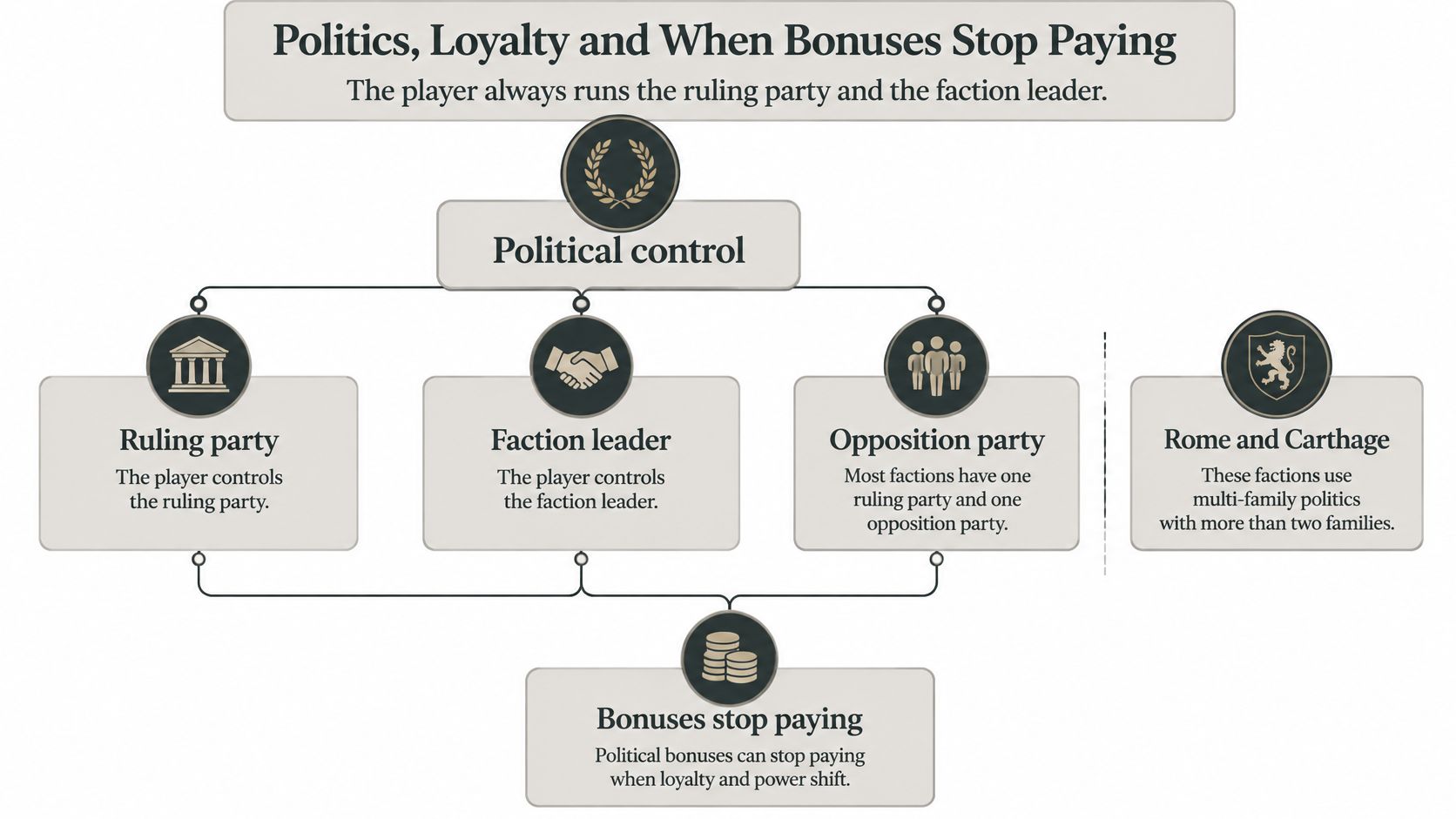
Gravitas turns generals into political weapons
A character's Gravitas measures their standing and contributes to their party's share of Influence. Giving an opposition general a prominent command can help win a border war, but victories can also strengthen that general's political position. Keep every important army with the ruling party and you may leave capable generals idle or concentrate too much responsibility in one family. Choose based on the army's location, the provinces influenced by each party, and the urgency of the war.
Rome makes that decision part of faction selection. You choose among the Julia, Cornelia, and Junia houses, each with a different package of economic, military, and cultural effects. Treat the house as part of your campaign build. Pick a military package if the opening demands it; choose economic or cultural strengths if those are the constraints likely to stall you. A battlefield advantage will not solve a weak treasury by itself.
The rivalry among Roman families reflects a political system built around competing elites. For historical context, how Roman governance changed under Augustus explains the shift from republican competition toward concentrated authority. In the campaign, manage the same pressure directly: keep powerful families useful, and prevent one party from gaining enough control to threaten the state.
The turn 20 loyalty check
Audit loyalty before the opening phase ends. The official Total War Academy for Rome II notes that after the first 20 turns, sufficiently negative loyalty can let a party break away with its generals and provinces, forming a new faction. A bonus to morale, income, or recruitment is a bad bargain if the party using it takes an army and territory with it.
- Check opposition loyalty: Find the party closest to open disloyalty, rather than focusing only on the party with the most influence.
- Map the generals: Identify which armies unhappy parties control and whether they are near your capital or richest province.
- Map the provinces: Plan for a breakaway to take territory. Reposition loyal forces before the danger becomes immediate.
- Price political actions: Compare the cost of restoring loyalty with the cost of replacing an army after a split.
Three breakpoints for spending a bonus
In the early campaign, use the faction's strongest tool to secure its first gains. Rome should take the infantry fights its army suits. Parthia should use mounted mobility, while Suebi should turn early aggression into territory before stronger administrations gain an advantage. Early strength matters most when it helps win a war before opponents have built out their capabilities.
In the mid campaign, invest in what the faction's signature trait does not provide. A morale advantage still needs food, public order, and civic technology. A wealthy faction still needs recruitment buildings in useful provinces, and a cavalry force still needs a way to handle sieges. Overcommitting to a faction's identity can leave excellent armies guarding unhappy cities, with no reserves and a party leader poised to defect.
In the late campaign, diplomacy and client states can be more valuable than another offensive army. Defensive alliances can protect a flank without requiring you to garrison it. Client states can buffer a border and leave your strongest force available for the decisive theater. Conquest still offers gains, but each new province adds demands on public order, food, culture, and political control. Judge every expansion by what it adds to both your economy and your political workload.
Downloadable campaigns change the balance of advantages and liabilities. In Empire Divided, Rome, Gallic Rome, and Palmyra gain regional morale advantages and research benefits, but face diplomatic costs with other Roman factions. Treat those benefits as reasons to plan around a region or technology path, not as permission to open wars everywhere. The advantage only pays when your economy, unit access, and party loyalty can support the campaign it encourages.
Ask what a bonus costs in diplomacy, loyalty, missing units, or delayed civic development. If you cannot name the cost, you have not built a plan around the bonus.
A bonus stops paying when it pushes you into a war your culture, treasury, or political structure cannot sustain. Choose the easier start when hostile borders and internal loyalty leave little room for error. Choose a stronger specialist only when its units and economy can support the political risk. Restraint protects the faction you chose from becoming its own enemy.
Landmark Factions with Opening Plans
The eight launch starts remain the best teaching set because each one makes a different mistake expensive. The official Total War wiki factions overview identifies three faction-specific technology branches, civic, military, and engineering, so each sketch below gives you a technology bias, not a universal research order. Major factions are playable and historically significant, while minor factions normally aren't playable but can expand and conquer territory around you.
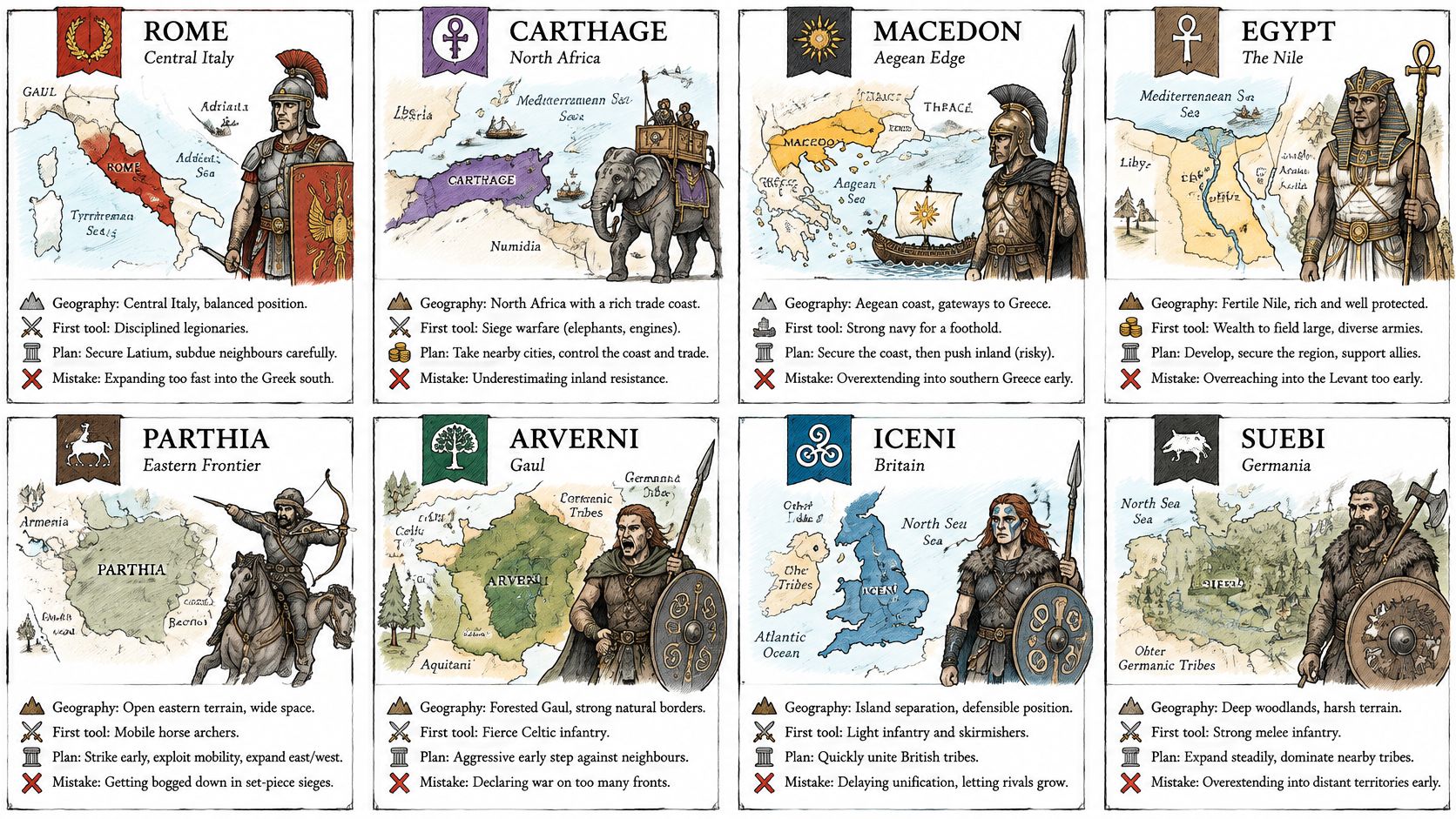
Western and central Mediterranean starts
Rome. Pick Julia, Cornelia, or Junia for the bundle your plan needs. Secure Italy first, fight with disciplined heavy infantry, and bias military technology when the next enemy can reach you immediately. Don't march north or south for several turns while ignoring which party controls your best general. Rome loses good campaigns through distraction more often than through one bad legionary battle.
Carthage. Build the campaign around fleets, ports, and trade before you accept a grinding land war with Rome. Protect African income and Iberian recruitment, and bias civic research when money and order gate your next fleet. Expect more than two political families. The mistake is treating a strong treasury as permission to open every maritime front at once.
Macedon. Use the phalanx as the anvil and cavalry as the hammer. Fight on ground where pikes stay dressed, pin the enemy center, and keep a mobile reserve for the flank that matters. Bias military technology toward the combined arms core. Don't chase light troops into broken ground with the pike line and call the resulting disorder bad luck.
Egypt. Convert wealthy provinces into recruitment and food security early. Mix eastern and Hellenic style troops according to the enemy in front of you, and bias civic technology when income must become sustainable armies. Pick one front. Egypt can afford several wars on paper and still lose tempo because every neighbor demands a separate response.
Watch one strong opening played at campaign speed before you copy an army template without seeing the map decisions around it.
Eastern, tribal, and island starts
Parthia. Stay mounted. Horse archers should stretch, empty quivers into, and isolate enemy units before heavier cavalry finishes the broken pieces. Bias military technology that supports that mounted roster. Don't build an army that secretly needs Roman style infantry to function. If a siege forces a slow infantry fight, bring mercenaries, use engineering support, or choose a different target.
Suebi. Raid and fight while your early aggression matters. Take nearby territory before richer factions turn infrastructure into better armies, then bias civic technology soon enough to stabilize public order. The mistake is conquering three settlements and discovering your warband economy can't hold them without constant rebellions.
Iceni. Use the sea as a wall with weather. Consolidate Britain, build a port and fleet plan, then choose one crossing into Gaul instead of raiding everywhere a transport can land. Bias engineering when buildings and movement into the next phase matter more than another marginal unit upgrade. Don't invade the continent with an unfinished home province and no reserve.
Arverni. Unite, cow, or defeat nearby Gallic rivals before Roman attention becomes the main event. Central position gives options, but options become encirclement if you make every neighbor angry. Bias civic technology when confederation and order need support, then shift military. Don't treat same-culture diplomacy as automatic friendship.
Downloadable content factions follow the same opening discipline. Name the start region, signature unit, political load, first hostile neighbor, and first 20 turn objective. If one field is blank, your opening plan is still a mood.
Cross References for Campaign Systems
Use cross references when a campaign problem looks like one system but belongs to another. Missing units, sudden province loss, weak armies, and stalled expansion often start outside the panel you're staring at.
Four checks before you blame the obvious system
- Culture to recruitment: If the unit you want is missing, check culture and building architecture before blaming technology. A Parthian player who needs durable infantry should hire mercenaries, recruit local support where available, or change theater. Don't expect Latin buildings to appear because you captured a city.
- Politics to the map: If a Roman province is slipping away, inspect opposition loyalty and general assignments before blaming the garrison. A party's generals and provinces are the secession prize, so transferring a character is also a military deployment decision.
- Diplomacy to culture: Same-culture neighbors often give you cheaper diplomatic openings, while settled and nomadic factions can pay extra friction when borders and building needs collide. Buy time where culture makes time cheap, and defend the border where it doesn't.
- Technology to role: Civic research supports order and economy, military research improves roster quality, and engineering supports infrastructure and siege or building needs. Choose the branch that removes the next campaign bottleneck, not the branch with the most exciting icon.
A Carthaginian player with a weak field army should inspect trade routes, ports, and fleets before declaring a land war to prove toughness. Your strategic weapon may be the income and sea control that let you choose where the land war happens. An Iceni player researching military upgrades still needs a port plan before continental expansion, because a better warband stuck on the wrong side of the Channel changes nothing.
Minor factions belong in threat assessment, not a footnote. An unplayable neighbor can conquer the buffer province you intended to take next, ally with your enemy, or grow while you fight a famous major faction. Check minor faction armies with the same seriousness you'd give Rome or Carthage when they're two turns from your capital.
Players who like comparing faction systems across strategy games can also use a mod-focused reference such as a guide to Empire at War mods and faction overhauls to see how different games solve roster identity and campaign balance. The useful transfer isn't a ranking. It's the habit of asking whether a faction changes units only, or whether it changes economy, diplomacy, map movement, and failure.
If the symptom is military but the cause is cultural, political, or logistical, another elite unit won't fix it.
If you haven't chosen a faction, return to the playstyle constraint and pick the row you can defend. If you have chosen, use the opening sketch for that start and audit the related system every few turns. Don't wait for a rebellion, secession, or empty recruitment queue to teach you which panels were connected.
Default Start and Turn One Lock-In
Start as Rome if you want the classic legionary campaign and you'll accept house politics as part of the price. It's the best default for learning heavy infantry, expansion around the Mediterranean, and the connection between generals and internal power. Choose the house for your economy, military, or culture plan, secure Italy, and complete your loyalty audit early.
Start as Iceni instead if fewer parties and a sea buffer matter more than immediate prestige. Start as Macedon if you want set-piece pike battles without Rome's family web. Those aren't consolation picks. They're lower-friction ways to learn the campaign while keeping one clear battlefield identity.
Don't start as Parthia unless you already like cavalry micro. Don't start as Carthage expecting a simpler Rome; it's the trade and navy alternative, with its own political and geographic spread. Ignore any tier list that calls one faction strongest on every difficulty, for every victory condition, and for every player. That list is measuring a roster in isolation, not a campaign you'll still enjoy after the opening wars.
Six point lock-in
- Name the constraint: Write it as a sentence, such as low management, trade first, pike battles, or cavalry micro.
- Confirm the culture: List the unit families and building style that culture gives you.
- Record the party structure: For Rome, write down Julia, Cornelia, or Junia before turn one ends.
- Mark two hostile neighbors: Choose the two factions most able to reach your first army or capital.
- Set the first technology branch: Civic, military, or engineering, based on the neighbor and bottleneck in front of you.
- Pick one victory direction: Commit to one compass direction before you recruit a second full army.
That lock-in gives your first turns a testable purpose. You'll know why you built the first building, why that general received the army, and why one border gets diplomacy while another gets war. Pick the Rome 2 Total War factions that fit your limits, then play the campaign you selected instead of auditioning for a different one every five turns.
Turn your favorite faction emblems, legionaries, cavalry, and campaign map props into polished 3D assets with Sculpty, a browser-based AI 3D studio for text-to-3D and image-to-3D generation, PBR texturing, remeshing, and game-ready exports. Build a tabletop miniature, a mod concept, or a 360 degree showcase for your next campaign idea, then export it for Blender, Unity, or 3D printing.