3D Printing Miniatures for Dnd: 2026 Guide to 3D Printing
You need a miniature for next week's game. It might be a distinct player character, a batch of anonymous NPCs, or a campaign creature that needs to stand out on the table. Your real choice isn't which printer to buy. You need to decide whether to design the character yourself, download or prepare an STL, order a finished miniature, or outsource a file you already have.
The right resource depends on creative control, STL access, print responsibility, visual style, order size, and intended use. This roundup follows that production path, from generating an original character to preparing a file, choosing fulfillment, and checking whether you can legally use the result. It covers seven practical options, including Sculpty for creators who want to turn an original concept into a 3D asset before exporting it for downstream printing. It isn't a replacement for every specialist miniature service, but it can remove several steps from the early design workflow. If your project involves a small accessory rather than a full figure, a 3D printed bat charm in PLA shows how printable concepts can also move beyond traditional character models.
Table of Contents
- 1. Text to 3D
- 2. Hero Forge
- 3. Eldritch Foundry
- 4. TitanCraft
- 5. ANVL Custom Miniatures
- 6. Shapeways
- 7. The Juniper Mint
- Top 7 D&D 3D Miniature Services Comparison
- Match the Resource to Your Print Plan
1. Text to 3D
Sculpty is the strongest fit when the miniature starts as an idea rather than an existing file. You can describe a character, creature, prop, or NPC concept in a prompt, select among Meshy, Hunyuan 3D, Rodin, Tripo AI, and TRELLIS 2, and run the work through one browser-based studio. That matters when the first generated result has the wrong silhouette or when one engine produces better anatomy while another produces more useful topology.
The workflow continues after generation. Sculpty supports AI-driven PBR texturing with 4K maps, one-click remeshing and retopology, 4K renders, and 360° turntable exports. You can download GLB, STL, OBJ, FBX, USDZ, and 3MF files for Blender, game engines, AR workflows, or 3D printing. For a D&D miniature, STL export is the important handoff, but the other formats help if the model needs manual editing before it reaches a slicer.
Best for original characters and rapid iteration
A prompt-to-mesh workflow is useful for a one-off NPC with an unusual weapon, a player character based on concept art, or a creature that doesn't exist in a ready-made STL library. Image-to-3D and multi-view workflows can also help when you have a sketch or several character references instead of a polished model. The output still needs inspection. AI-generated geometry can produce weak contact points, unclear faces, thin weapons, awkward hands, or details that look attractive in a render but won't survive a physical print.
Practical rule: Treat the first generated mesh as a starting point, not a guaranteed print-ready miniature.
Sculpty's remesh and retopology tools reduce external cleanup, but they don't eliminate the need to check watertightness, scale, wall strength, overhangs, and support placement. A small facial feature may need to become a stronger sculpted form, while a cloak or weapon may need to be thickened before export. Paid plans provide commercial usage rights, and credits, exports, and assets stay organized in a private gallery, so review the applicable plan terms before selling physical prints.
The platform is especially convenient for creators who don't want to install several desktop tools or maintain separate accounts for multiple generation engines. Its weakness is the same as every AI-assisted 3D workflow: prompt quality and engine choice influence the result, and demanding miniatures may still require Blender or another modeling application. For a creator who wants to explore several visual directions before committing to a print, however, the unified workflow is difficult to match.
2. Hero Forge
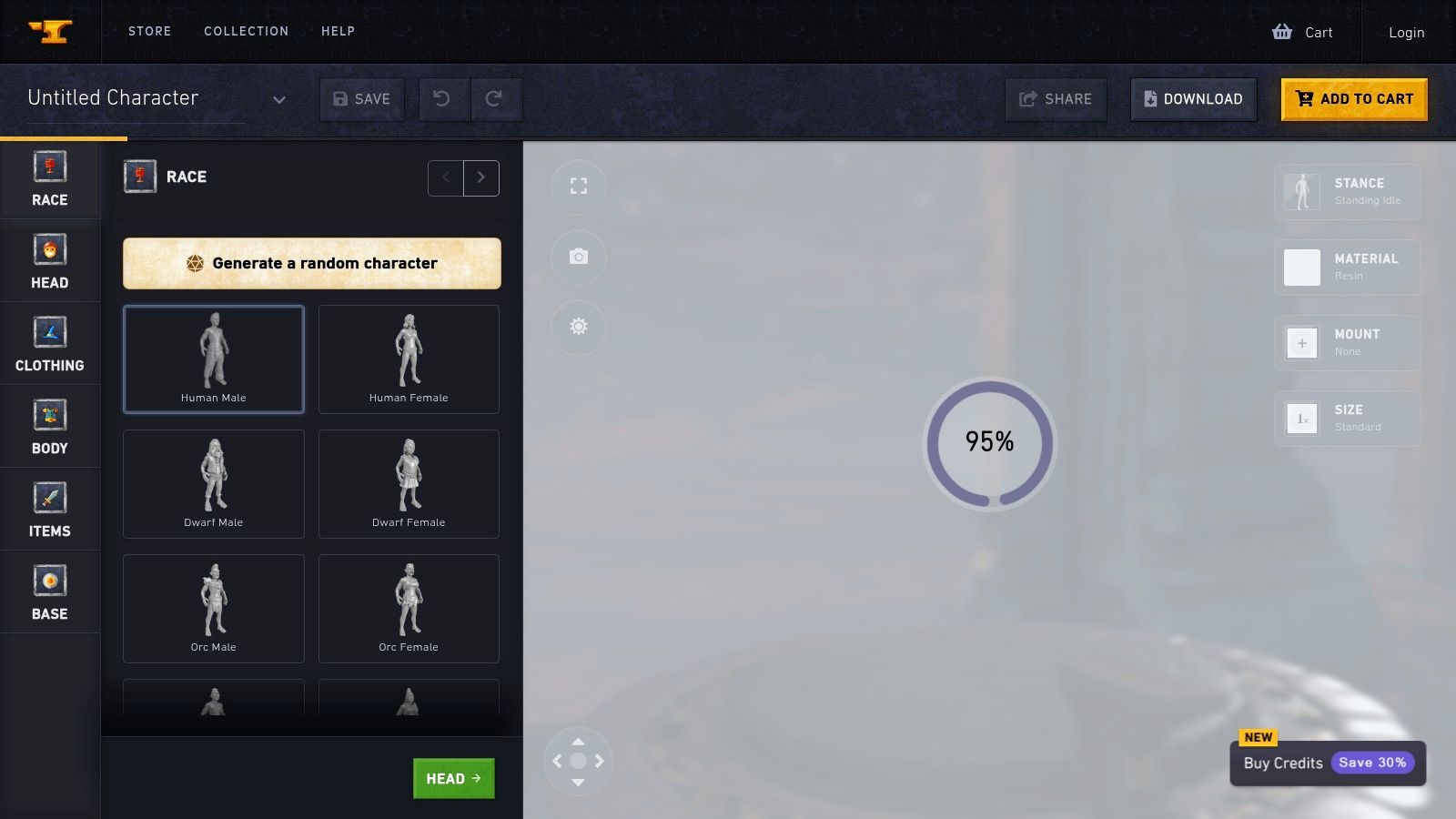
Hero Forge is the safest choice for a player who wants to build a recognizable fantasy character without sculpting from scratch. Its browser creator offers a deep library of races, clothing, weapons, poses, bases, mounts, and accessories. You make decisions visually, rather than writing prompts and repairing unpredictable geometry.
Best for a finished character with minimal technical work
The service supports both physical fulfillment and digital output. You can order a miniature in materials that include Standard or Premium plastics, full-color plastic, and metal options, or download an STL for local printing or a third-party bureau. That gives you a useful fallback. If the physical delivery timing or material isn't right for your campaign, you can take responsibility for the file yourself.
The visual language is a major part of the decision. Hero Forge characters tend toward a clean, heroic, slightly stylized appearance. That works well for adventurers, recognizable party members, and readable tabletop silhouettes, but it may not suit a grimy horror campaign or a highly naturalistic monster. Large designs, mounts, and extra accessories also add complexity to the physical order, so review the final model rather than assuming the base character price tells the whole story.
For creators who want to understand the file handoff before downloading, this guide to creating 3D printer files provides useful context around the preparation stage. It doesn't replace Hero Forge's own material, printing, or licensing terms, which should remain the authority for your order.
Where it saves time and where it doesn't
Hero Forge works best when you know the character's equipment and pose. It isn't the right tool for generating a completely original anatomy or an unusual creature outside its component library. It also isn't the cheapest route for every elaborate design, particularly when the model includes a large base, mount, or many attached parts. Still, it offers the most direct path from character brief to delivered miniature for users who don't want to own a resin printer or manage supports, washing, curing, and finishing.
3. Eldritch Foundry
Eldritch Foundry suits players who want a character builder but prefer a more grounded, gritty, or realistic visual direction. Like Hero Forge, it lets you assemble a figure in the browser using controls for race, equipment, pose, and base. The difference is felt most clearly in the part library and overall aesthetic, so the best choice often comes down to which creator produces a character that already looks close to your campaign.
Best for a darker visual style
The practical advantage is that you can design the miniature without learning a modeling package, then order a high-detail resin print and have it shipped. Resin is the practical standard for detailed D&D miniatures because MSLA printers can work at 18 to 50 micron layer heights, with XY pixel sizes down to about 17 to 35 microns. Guidance for miniature buyers recommends at least a 4K panel, with 8K or 10K preferred, and an XY pixel size at or below 35 microns for facial features, chainmail, and other small details. Those specifications explain why a resin-focused fulfillment route is usually a better match than a general FDM service for a small, highly detailed character. Independent miniature printer guidance covers the technical reasoning behind those requirements.
Eldritch Foundry's STL availability can vary by offer or campaign, so don't assume every purchase includes the same digital rights or file access. Check the current product terms before you commit if local printing, editing, or commercial use matters. The platform has also offered promotions and affiliate pickup or delivery through game stores in some circumstances, but availability depends on the current program and location.
The important checkout question
The builder is convenient, but pricing may not be fully clear until you reach the cart or checkout. That makes it harder to compare a basic hero with a heavily equipped character before investing time in the design. Fewer material and fulfillment modes can also matter if you want full-color output, metal, or a particular local printing route.
Choose Eldritch Foundry when the look of the assembled character is more important than having the broadest material menu. It is particularly useful for a single hero, villain, or unusual NPC where the style does more work than absolute control over the mesh.
4. TitanCraft
TitanCraft takes a different approach from a one-time character order. It focuses on kitbashing from purchased asset packs, allowing you to combine owned parts into many variations. That makes it a better production tool for a game master who needs recurring NPC types, a creator developing a coherent faction, or a seller who wants to make multiple physical designs from a licensed library.
Best for repeatable character production
The key distinction is ownership of the purchased asset packs. TitanCraft lets users export unlimited STLs using assets they own, rather than treating every variation as an entirely separate design purchase. You can also order high-detail gray-resin prints directly through the platform. For personal campaigns, that creates a practical route from a reusable collection of parts to a growing roster of characters.
The part library determines whether the model works for you. TitanCraft is cost-effective only when the available packs match your needs and you expect to make more than one design. If you need a very specific item that isn't included, buying packs can be less efficient than using a broad one-off customizer. The finished resin models also carry familiar trade-offs. Thin swords, extended limbs, and large unsupported elements still need careful handling, and a larger or more complicated model uses more material and may cost more to print.
A reusable asset library is valuable only when it supports the characters you actually need to produce.
TitanCraft stands out for its merchant license program. If you plan to sell physical prints made from TitanCraft assets, read the current merchant terms rather than relying on a personal-use assumption. A downloaded STL isn't automatically permission to sell copies, and the commercial path depends on the specific license attached to the assets.
For an occasional player, TitanCraft may feel like more setup than necessary. For a frequent creator, it offers a stronger long-term workflow than repeatedly rebuilding characters from scratch. Its best use case is a campaign or small print business where consistent parts, repeatable exports, and clear commercial permissions matter.
5. ANVL Custom Miniatures
ANVL Custom Miniatures is a useful middle ground for people who want hands-on character design without committing to a full desktop modeling workflow. Its browser and mobile-friendly builders cover races, outfits, gear, poses, and bases. You can either order a high-resolution resin print or download an STL for your own printer or a local service.
Best when you want choice at the handoff
The two fulfillment paths are ANVL's biggest practical advantage. A player who needs one campaign-ready miniature can order a physical print, while a hobbyist who already has a printer can download the file and control resin, supports, scale, and post-processing. That flexibility also helps when an order needs to be combined with other models in a local print run.
The builder's style has enough variety to appeal to users who find some larger platforms too uniform. Its ecosystem and part library are still smaller than the market leader's, though, so you may reach a creative limit sooner when designing an unusual creature or an equipment-heavy character. Public pricing can also be less transparent, with the exact total appearing at checkout. Build the figure far enough to see the complete cost before treating it as a direct price comparison.
A downloaded file still needs to be prepared for the intended printer. This practical guide to STL files for 3D printing explains why a file's format is only one part of a successful physical workflow. Inspect the mesh, verify the scale, and ask whether the model comes supported or requires your own support strategy.
ANVL is a sensible pick for a single hero, a small party, or an NPC where you want more control than a ready-made miniature provides. It isn't the strongest choice for a large asset-production pipeline, and it won't remove the need to check commercial terms if you plan to sell the resulting physical prints.
6. Shapeways
Shapeways is for the stage after character design. You bring the STL, upload it, review the automated file checks, choose a material and finish, receive a quote, and place the order. There isn't a D&D-specific character builder or catalog doing the creative work for you, so its value comes from professional manufacturing options and a repeatable upload-to-order process.
Best for a file you already trust
This route works well when you have a Sculpty export, a purchased STL with the correct permissions, or a model made in Blender. Shapeways offers materials that include Fine Detail Plastic and resin options suitable for small gaming models, along with broader manufacturing and finishing choices. That gives you more control over the physical specification than a character platform that offers only its own standard output.
The trade-off is responsibility. An automatic file check can identify certain issues, but it doesn't guarantee that a tiny hand, spear, cloak edge, or unsupported accessory will produce the appearance you expect on the table. Before ordering, inspect the model in a web viewer or slicer, confirm its scale, and check whether the selected material is appropriate for a miniature rather than a larger decorative object.
Wall strength becomes particularly important when you upload a model that wasn't designed specifically for manufacturing. This guide to wall thickness for 3D printing is useful during preparation, but the bureau's current material rules and manufacturing guidance should take priority.
Shapeways makes more sense for a polished one-off, a small batch, or a creator who wants a professional supply chain rather than a hobbyist printer. Material, finishing, shipping, and lead time all affect the final decision, so compare the complete order rather than the base manufacturing quote alone.
7. The Juniper Mint
The Juniper Mint is the boutique option for people who want miniature-specific attention instead of a general manufacturing portal. You can upload STL or OBJ files for printing, request a quote, or choose from a curated collection of ready-to-order miniatures and terrain. The service emphasizes hobby-grade resin settings, high detail, and direct communication before and after the sale.
Best for one-off heroes and small orders
That personal contact is useful when a model has a questionable weapon, a fragile pose, or a base that needs discussion. A miniature-focused printer can assess the file in the context of tabletop use rather than treating it as one more industrial upload. The service also suits customers who don't want to learn resin handling but still care about crisp detail and a hobby-ready result.
The main limitation is speed of price comparison. The Juniper Mint uses a quote-based process, so you need to upload the file and wait for an assessment instead of seeing an instant total. Its throughput is also more artisanal than a large bureau, which may be an advantage for a careful one-off but less convenient for a campaign that needs a substantial batch on a fixed deadline.
Use this route when the file is already chosen and the physical result matters more than automated ordering. Ask about scale, resin type, support marks, cleanup, curing, and whether the print arrives finished or requires your own preparation. If you plan to use a purchased model commercially, provide evidence of the relevant license and confirm that the requested production is allowed.
The Juniper Mint is the strongest fit for a single player character, memorable villain, or small NPC order where communication and miniature-specific handling outweigh instant quotes. It isn't the obvious choice for unlimited self-service production, but that isn't what a boutique print shop is designed to provide.
Top 7 D&D 3D Miniature Services Comparison
| Platform | 🔄 Implementation Complexity | ⚡ Resource Requirements | ⭐ Expected Quality | 📊 Ideal Use Cases | 💡 Key Advantages |
|---|---|---|---|---|---|
| Text To 3D (Sculpty) | 🔄🔄🔄, Browser-based, multi-engine pipeline, one-click postprocess | ⚡⚡, Internet + credits/paid plans; no local installs | ⭐⭐⭐⭐, Production-ready meshes often; engine-dependent | Generate/export game/AR assets, fast iteration, 4K renders & turntables | Multi-engine choice, integrated PBR/texturing, remesh/retopo, broad export & unified rights |
| Hero Forge | 🔄🔄, Simple in-browser builder with deep part library | ⚡⚡, Low technical; pay-per-print or STL download | ⭐⭐⭐⭐, Reliable, stylized minis suitable for tabletop | Quick custom minis, direct ordering and VTT assets | Largest part library, easy end-to-end print fulfillment, STL option |
| Eldritch Foundry | 🔄🔄🔄, Web builder with campaign-driven features | ⚡⚦, Print-focused; material options more limited | ⭐⭐⭐⭐, High-detail resin minis, grittier aesthetic | Resin prints for realistic minis; store-affiliate pickups | Distinct realistic style, retail/affiliate shipping options |
| TitanCraft | 🔄🔄🔄, Kitbashing from purchased asset packs; export-focused | ⚡, Upfront asset purchase; unlimited STL exports thereafter | ⭐⭐⭐⭐, Mini-focused detail depends on owned packs | Frequent creators, sellers, kitbash-heavy workflows | Permanent asset ownership, unlimited exports, merchant license for sellers |
| ANVL Custom Miniatures | 🔄🔄, Clean browser + mobile builder, two fulfillment paths | ⚡⚡, STL download or resin print; promo-driven pricing | ⭐⭐⭐⭐, Good stylistic variety and print quality | Mobile-friendly customization, small-batch printed minis or STL | Smooth UX, mobile support, promotions and knowledge base |
| Shapeways | 🔄🔄🔄🔄, Professional bureau; upload, auto-checks, enterprise workflow | ⚡⚡⚡, Wide material/finish choices, shipping and lead time costs | ⭐⭐⭐⭐⭐, Consistent, repeatable professional output | One-offs or small batches requiring fine-detail materials | Broad material selection, instant quoting, reliable manufacturing pipeline |
| The Juniper Mint | 🔄🔄🔄, Boutique upload-to-print with hands-on service | ⚡⚡, Quote-based pricing; artisanal turnaround and contact | ⭐⭐⭐⭐, Hobby-grade premium resin with careful finishing | Small orders, one-off heroes/NPCs, hobbyist customers | Miniature-specific expertise, premium resin finishes, personal service |
Match the Resource to Your Print Plan
Start with the object you need, not the platform you happen to find first. If the miniature exists only as a character idea, use Sculpty to generate and refine an original asset in the browser, compare generation engines, clean the mesh, and export an STL for the next stage. Sculpty is most useful when creative control and rapid iteration matter more than selecting parts from an established character library.
Choose Hero Forge, Eldritch Foundry, TitanCraft, or ANVL when the priority is hands-on character customization. Hero Forge offers the broadest familiar route from assembled character to physical order or STL. Eldritch Foundry is compelling when its darker visual style fits the campaign. TitanCraft makes more sense when you expect to reuse purchased assets across many variants or need to investigate a merchant license. ANVL is a practical option when you want both a physical resin order and a digital STL route from a mobile-friendly builder.
If you already have a trustworthy STL or OBJ, skip the character configurators and look at fulfillment. Shapeways is the more structured bureau workflow, with upload checks, material selection, quoting, and order management. The Juniper Mint is better suited to a small or one-off miniature where direct communication and miniature-focused judgment are worth the quote-based process.
Resin remains the practical choice for fine D&D character detail, but that doesn't mean resin ownership is automatically the cheapest route. One independent guide estimates a standard 28mm resin miniature at roughly $0.15 to $0.50 in resin, or about $0.30 to $0.75 including electricity and FEP wear, while a full plate of 10 to 15 models costs about $3 to $8 in materials. Those figures are from a cost-focused miniature printing guide, and they don't remove the need to account for washing, curing, consumables, failed prints, workspace, and your time. If you print infrequently, outsourcing may be the more economical choice even when the raw resin cost looks low.
Before ordering or slicing, inspect the exported file, confirm the miniature's scale, and verify that thin features and contact points suit physical printing. Ask the chosen service about supports, wall strength, material, finish, shipping, and whether the file is supplied pre-supported. Finally, read the applicable personal-use, commercial-use, and merchant-license terms before selling prints, producing miniatures for clients, or using someone else's assets in a paid project.
Sculpty gives D&D creators a browser-based path from an original prompt or image to a cleaned, textured, and exportable 3D asset, with STL support for downstream printing workflows. If you want to create a custom hero or creature before deciding whether to print locally or outsource, visit Sculpty and test the generation and preparation workflow for your next campaign miniature.